IDA Yearbook 2021 (2020 Review • 2021 Preview), pp. 26-27
↓ Readable PDF↓ Original pages (scan)
A non-technical explanation of the aerodynamics behind genoa trim on a Dragon. Upwind, the genoa produces about twice the force per unit area of the mainsail, and the boat goes best with a light rudder pressure (rudder angle under 5 degrees) and 10–15 degrees of heel. The article explains how the slot between genoa and main controls the flow, why a slot that narrows too abruptly or too much backwinds the main, and how stagnation-line diagrams illustrate this. It then covers the three ways of changing genoa shape (luff tension via the halyard, forestay sag via runner and mainsheet, and clew position via sheet lead, barber hauler and sheet), with settings for flat water and for waves.
To understand why you make adjustments to the genoa’s sheeting position and trim (runner tension, halyard tension, etc), it is good to know a little about how the aerodynamics around the sail work. This article does not have the ambition to provide the reader with any in depth knowledge of the subject but to give a quick insight into how the aerodynamic and hydrodynamic forces cooperate on a sailboat.
When sailing upwind, the aerodynamic forces in the genoa are about twice as strong as they are in the mainsail per unit of area and so they are more effective. It is important to find the right interaction between mainsail and genoa for this relationship to occur: that the genoa is properly tuned.
That the mainsail should have the correct trim is, of course self-evident, but here we will take a closer look at how and why we trim the genoa for optimum performance in different winds and sea conditions.
Most people know that a sailboat can sail upwind because with a correctly sheeted sail a negative pressure is formed on the leeward side of the sail and a higher pressure on the windward side of the sail and these pressure differences create a so-called lifting force. This applies provided that the air flow on the leeward side is free from turbulence.
The lifting force in each part of the sail is directed perpendicular to the sail’s surface. The force is greatest in the front third of the sail and gradually decreases towards the back (leech). In simple terms, it can be said that the lifting force can act perpendicular to the sail’s chord (the straight line between the front and the back of the sail). Since the sail is sheeted at an angle deviating from the boat’s centre line (line from bow to stern), the lifting force points obliquely forward. The force can in turn be divided into a force parallel to the boat’s centre line – the propelling force, and a force perpendicular to the centre line. The perpendicular force creates a drift (sidewards movement) on the boat and a heeling force (causing the boat to heel).
These two forces are counteracted by a similar force situation below the waterline where the shape of the hull, keel and rudder create a hydrodynamic force that largely neutralises the drift. The heeling forces are balanced by the keel weight and the crew’s eagerness to hike. In this context, it is good to know that the large rudder on the Dragon contributes to the keel’s lifting force, which is of course directed towards the wind and reduces drift.
When you sail upwind, a lifting force is created on the rudder blade and the helmsman experiences it as a light pressure on the tiller. This pressure is beneficial with a small rudder angle <5 degrees and it helps to reduce drift. If the rudder angle becomes larger, the rudder begins to act as a brake and the heeling increases and the speed decreases. For the Dragon to sail upwind as well as possible, it is important to find the fine balance between a light but still distinct rudder pressure which does not stop the boat and one that does. It is important to sail the boat with a small but accentuated heel, to achieve this pressure, 10-15 degrees is optimal. For this to happen, the sails must be trimmed correctly and in balance with each other. Properly sheeted sails affect the gap between the genoa and the mainsail and it is the wind flow between the sails that controls the angle of attack of the wind towards the front end of the genoa and this affects how high we can sail.
If you look at the genoa and mainsail separately in an air stream, you can see that the air on the leeward side of the genoa has a smoother undisturbed flow when compared to the mainsail. This is because the air flow around the mainsail is disturbed by the mast profile. The negative pressure on the leeward side of the genoa is stronger than the negative pressure on the leeward side of the mainsail.
The air flow that passes between the genoa and the mainsail is slowed down, compared to a free streaming airflow, due to the narrowing of the gap between the two sails. The more even the slot between the sails, the less the slower wind is disturbed and more air is led down the leeward side of the genoa, which consequently becomes more efficient. However, this is at the expense of the negative pressure on the mainsail’s leeward side which is reduced and so the mainsail becoming less efficient.
If the gap between the genoa and the mainsail becomes too narrow, the wind is slowed down too quickly and the negative pressure on the mainsail’s leeward side is reduced even more and becomes equal to the pressure on its windward side or even higher and that will cause the mainsail to backwind.
If you sail with elements of backwind in the leading edge of the mainsail, you have lost the positive properties that a perfectly tuned gap can provide. The result is that the amount of air that would pass the leeward side of the genoa instead passes to the windward side of the mainsail. The genoa loses some of its power and you will sail a little lower.
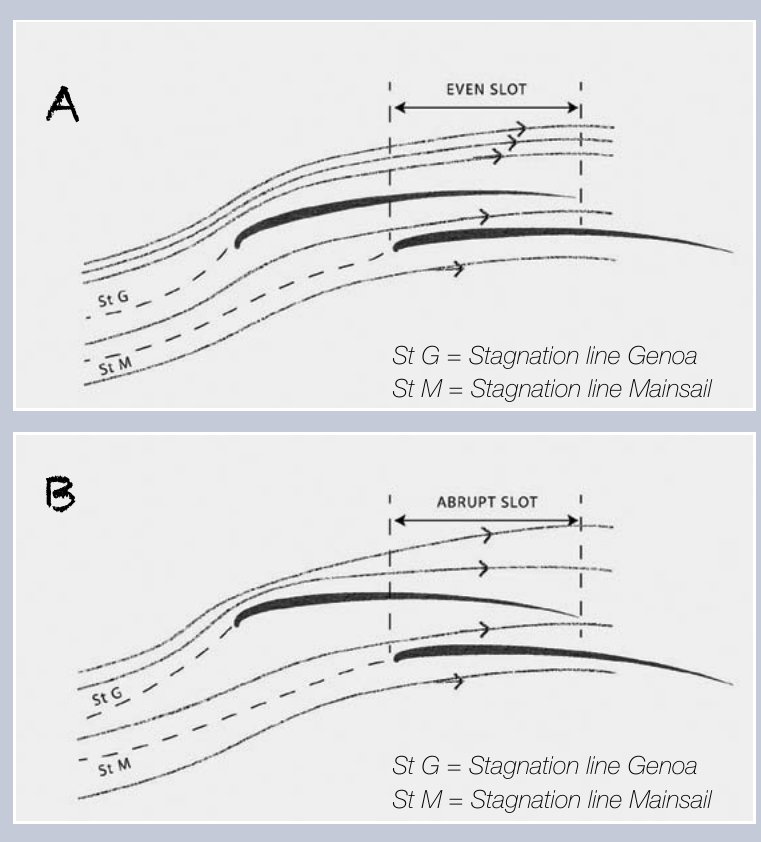
You can separate the airflow that goes on the leeward side of the sail from the airflow that goes on the windward side of the sail by a theoretical line called stagnation line (St). It is only the amount of air that come out from the slot that also goes into the slot.
This is illustrated in the diagrams A and B of the stagnation lines. The distance between the stagnation lines are the same as the width of the slot.
If the slot narrows too abruptly (Fig B) from where the overlap starts and to where it ends, the speed of the airflow slows down more quickly than if the slot narrows more evenly (Fig A).
The slower the airflow is, the less pressure difference there is on the leeward and windward side of the main.
More of the airflow goes to windward of the main and less on its leeward side. The diminishing of the negative pressure on the main influences the airflow around the genoa so less airflow goes around on its leeward side. That cause the airflow to change from the leeward side to the windward side and the angle of attack goes more forward. Compare stagnation lines in Fig A and B.
More of the subject can be found in The Art and Science of Sails by Tom Whidden and Michael Levitt and in articles written by scientist Arvel Gentry.
How we trim the genoa also affects the mainsail’s trim because the sails work together.
Genoa shape can be affected in three ways and almost always in combination.
- you can vary the tension in the luff between loose and hard. This is done with the help of the genoa halyard.
- you can vary the forestay sag, ie the forestay bulge to leeward and aft. It is the tension in the runner (running backstay) and the sheeting of the mainsail that affects the tension in the forestay and its sag.
- you can move the genoa clew in three directions. Up-down, inward-outward, backward-forward. This is controlled by the sheet lead, the barber hauler and the sheet.
The tension in the forestay affects the fullness (depth) of the genoa. The looser the fore-stay, the deeper the sail, especially in its upper part. The tension in the luff affects the location of the deepest part of the sail. Increased luff tension moves the fullness in the genoa forward and at the same time flattens the aft part. A straighter back edge to the sail (leech) gives a smoother slot.
The genoa must be sheeted so that the leech is parallel to the leeward side of the mainsail. This is best seen from the foredeck where you have a good overview along the entire slot from the top to the bottom.
The fullness in the lower half of the genoa and the twist of the sail varies with the position of the genoa clew in the fore aft direction, which is a combination of position of the genoa sheeting point and how hard you sheet the sail.
The width of the slot between the mainsail and the genoa is controlled with a barber hauler. In light winds you can have a narrower slot and the fullness further aft in the sail while you must have a wider slot in higher wind strengths to allow more air per unit time to pass through the slot without reducing the negative pressure on the mainsail’s leeward side. You should not have back wind in the leading edge of the mainsail.
When sailing in flat water and steady wind, you can have a straighter leading edge on the genoa. It is regulated with a slightly higher forestay tension / runner (backstay) and a slightly looser halyard tension.
When sailing in higher seas, you often steer the boat on a more variable course and the wind’s angle of attack to the front of genoa varies all the time. If the angle of attack becomes too great, the wind does not follow the leeward side of the sail, but you get a turbulent air flow on the leeward side. This is the worst thing you can have if you want good drive in the sails. A rounder leading edge provides higher tolerance to turbulent airflow. Increased halyard tension gives a rounder leading edge.
It is important to point out that when you increase the halyard tension, you hoist the sail a little higher and at the same time you raise the genoa clew. This means that you have to adjust the sheeting point backwards / upwards at the same time as adjusting the halyard tension otherwise you risk having a sail that is sheeted too hard.
Every serious Dragon sail maker has accurate tuning manuals that clearly report how to set the sails for different wind strengths. This article makes an attempt to explain why.
Originally published as “Sailshape and why it matters – Understanding the Genoa” in the IDA Yearbook 2021 (2020 Review • 2021 Preview). © International Dragon Association. Reproduced with permission.
← Back to the Technical Library