By Ivan Coryn · BDA Magazine 1990 Christmas, pp. 10-11
↓ Readable PDF↓ Original pages (scan)
Ivan Coryn of Hood One Design explains how genoa design and trim affect helm balance and speed to windward: too much power in the genoa relative to the main gives lee helm, too much in the main gives weather helm. He shows the stress map of a crosscut genoa and describes the five main controls – sheet tension, Barbour haulers, athwartships tracks, halyard tension and runners. As a guide, set the Barbour hauler so the seams on the lower two-thirds of the sail run parallel with the side of the boat and those in the upper third twist off 5–10 degrees, and expect to play the runner fine tune over about 2 cm upwind.
Ivan Coryn of Hood One Design, Dragon sailor, designer of championship-winning sails for J24, Flying Fifteen, X.O.D., Sonata and Dragons, gives his thoughts on designing and sailing with today’s genoas.
How often does one hear someone say “my boat feels sluggish in waves”, “she doesn’t accelerate from the starting line”, “she’s slow out of tacks”. Fast sailors have a fine sense of feel for how their boat is performing, as well as an ability to rapidly change gear to respond to changing wind and wave conditions. The way your Dragon is coping with different wind and sea conditions is in part transmitted to the helmsman through the tiller, by feel, that is the amount of lee or weather helm that is present.
| Tiller | Weather helm | Too much power in main |
|---|---|---|
| Lee helm | Genoa too powerful relative to main |
Too much power generated in the genoa relative to the main develops lee helm and conversely too much power in the main relative to the genoa develops weather helm, either situation making the boat feel out of balance and often slightly sluggish through the water. A well designed Dragon genoa which both you and your crew understand how to use therefore plays a vital role in obtaining optimum speed to windward.
Sail design is a form of construction engineering; understanding the stress map below has allowed me to create a form of construction which best allows the sail shape to respond to adjustment of the controls available on the Dragon.
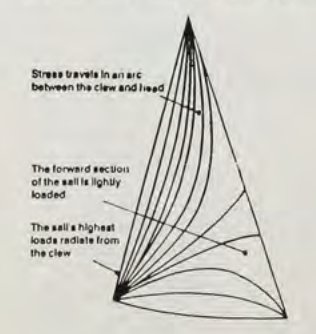
Principal sail controls available are sheet tension, Barbour haulers, athwartship genoa tracks, halyard tension and running backstay tension; all of which inter-connect in their effect.
When designing a Dragon genoa these controls must be taken into account. A strong low stretch material for the leech makes for easy Barbour adjustment; a light material for the luff gives sensitivity to halyard adjustment. Correct choice and placement of materials means the overall depth of camber is easily controlled by the runners.
To get the best performance from the genoa we must consider how each sail control works individually.
Sheet tension
This controls the angle of attack and overall chord depth of the sail for a given point of sailing. On the wind easing sheets develops more power, helping the boat to accelerate through the wash of a powerboat for example.
Barbour haulers
Standard on almost all Dragons, this controls the leech profile of the genoa, and thereby the shape of the slot created between it and the leading edge of the mainsail. Tightening the Barbour reduces twist, increasing the potential pointing ability of the sail. Too much, however, and the sail begins to stall, producing a negative effect on boatspeed. A useful guide in a crosscut sail, such as that drawn above, is to set the Barbour so that the seams over the lower 2/3rds of the sail are running off the sail parallel with the side of the boat, whilst those in the upper 1/3rd are twisted off between 5 and 10 degrees.
Athwartships track
This controls the width of the slot for a given Barbour hauler setting; easing the tracks down widens the slot, helping keep the hull upright and driving in a strong gust.
Halyard tension
This and runner tension complement one another, both playing a part in controlling the fullness of the entry of the sail. Halyard tension directly controls the fullness as the sail leaves the forestay wire, thereby widening or narrowing the groove that the helmsman has to steer the boat by. In flat conditions it is easy to sail to a fine entry, however as sea builds one must be able to luff and bear away without stalling the sail, to gain maximum speed to windward.
Runners
These affect the overall camber depth of the aerofoil, hence easing the fine tune, and powering up the rig to compensate for loss of breeze or set of waves. Upwind you should expect to play the fine tuning such that the wire passing through the deck is moving over a range of 2 cm. The effect on the sail profile should be monitored through the spreader observation window set in the mainsail.
Whatever the technology, the most important ingredient of evolving a fast design or sailing fast is to enjoy one’s sailing. Good luck next season.
Originally published in the BDA Magazine 1990 Christmas. © Ivan Coryn and the British Dragon Association. Reproduced with permission.
← Back to the Technical Library