By Graham Bailey · BDA Magazine 2006 Annual, pp. 12-13
↓ Readable PDF↓ Original pages (scan)
Graham Bailey looks at what the tiller tells a Dragon helmsman sailing upwind, starting from how to hold it: with the minimum grip that keeps control and the maximum feel. Waves make the tiller load up and unload; in short Dragon-venue waves he prefers to hold a straight course, locking the tiller-arm elbow (or the extension against the coaming) rather than steering over each wave. He notes the boat is fastest upwind when weather helm is momentarily neutralised or ‘released’, and suggests applying a fraction more helm then releasing it as the waves arrive.
Graham Bailey evaluates the tiller’s potential contribution to boatspeed.
Of all the moving parts on the Dragon, the tiller is the most overlooked in terms of its potential contribution to boatspeed. Everything else, such as the basic geometry of the rig, tensions, sail shapes, trim and direction, can be quantified. Yet the main instrument connecting the helmsman to the Dragon, through which he (or she) may feel the effects of all of the rest of the quantifiable variables, is largely incapable of useful measurement. This leaves us to cope on the basis of feel.
This short collection of thoughts is not concerned with usual discussion as to rig tune, boat trim, sail shape, kinetics or other visible techniques but simply about what we can begin to learn through what the tiller is telling us while we sail along in a straight line, upwind, with apparently not much else going on.
The writer, having sailed numerous different types of dinghies, dayboats and various large, medium and small offshore racing boats, never gave the tiller a second thought, and steerage generally was taken for granted until he was given a lesson in feel by a certain Danish Dragon ace who made a guest appearance aboard an Admiral’s Cupper in 1999. Paul took hold of the wheel and after about 40 seconds, asked: “the front of the rudder … is it round in section?” Of course, it was but how on earth could he tell that just by holding the wheel?
The answer is that our Dane has developed an almost super-human sense of feel which the rest of us could only ever aspire to – and we should. We can all improve our steering and our speed by learning to take more notice of what the tiller has to tell us.
Perhaps we should begin with the tiller/human connection, or, how to hold it. Golfers have thought about this in much more detail than we have. They understand better than anyone the importance of grip. They need to achieve a reliable connection with their club that is sufficiently firm to give them control yet not so tight that they lose all feel. In this respect, the sailor has the same issues as the golfer with the added entertainment of a club that fights back.
Upwind, the club, or rather the tiller, tends to exert a leeward pressure commonly and unimaginatively known as ‘weather helm’. Generally speaking, a very small amount of weather helm is a good thing and we can ‘feel’ the pressure we are most comfortable with. The pressure should be just sufficient that if we let go of the tiller, it will move slowly to leeward and the boat will luff up. Actually, that is what the text books say, but we have to tune in to something much more subtle than that.
We should apply the minimum grip to keep the tiller under control thereby retaining the maximum feel which will enable us to feel anything else which might be going on such as a variation in the amount of weather helm.
Aside from the general background pressure, the tiller will also talk to us when we negotiate waves. We have a constant slight pressure as we maintain a course upwind but that will increase and then reverse as the bow first rises up and over a wave and then falls down the other side. The issue at this point is that if we have maintained just sufficient pressure to ‘feel’ the weather helm, then we will not have sufficient control to stop the tiller coming toward us as the bow begins to drop on the down side of the wave. This is compounded with a bad set of waves where the tiller will be fighting for all its worth or shouting at us.
There are texts which will say that you should luff up as the wave approaches and bear away as you accelerate down the back of the wave. The tiller naturally wants to lend itself to this net result, and it may be fast in long-rolling waves but most Dragon venues will be in waves of a length that is too short for the benefits of direction changing (responding to the apparent wind consequences of decreases and increases in boatspeed) to outweigh the disadvantages of not holding a straight course.
Aside from loss in speed, there is great potential to lose height as the boat pivots on the top of the wave, the tiller unloads and possibly pushes from leeward (lee-helm). We are looking to minimise both types of losses.
Each individual can find a way of dealing with these issues but the writer prefers a combination of two techniques. The first way of controlling the changes and occasional reverses in pressure is to lock the tiller arm elbow in position. This in combination with an appropriate firming of the grip tends to steady her up more effectively than tightening the grip alone. If you are faced with a particularly short, and difficult series of waves such as would be created by a passing motorboat, the way to be absolutely sure that you will not lose ground to leeward is to put the tiller extension down to the coaming and to hold it there until the waves have passed. The writer will engage an extended tiller hand finger to lock the extension firmly against the coaming and at this point, the Dragon will pitch and the tiller will push and pull and generally nag but the course will be true throughout.
In stronger winds, the waves are a constant battle as the bow tends to fall to leeward over the back of the wave which in turn loads up the tiller before the process repeats itself – the boat ‘staggers’. The simple cure is to deploy the elbow lock to prevent the fall off and you will hold a steadier and higher course without the constant struggle. This is an extremely powerful technique and yet it is nothing more than holding her steady, and perhaps slightly higher than she would otherwise want to be sailed when there is so much bow out of the water on the tops of the waves.
The helmsman’s new-found levels of control and feel will tell him that, periodically, weather helm is released independently of any wave activity. This can be due to small changes in trim, weight distribution, apparent windspeed or perhaps we lost concentration and loaded the tiller up for a few seconds (photo 1), which then gave a period of zero helm until she settled back into her preferred mode.
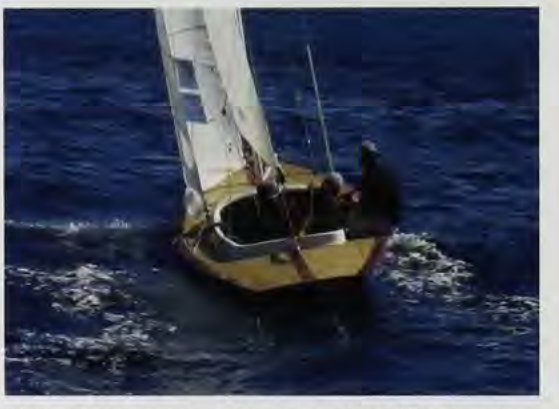
Having said earlier that a very small amount of weather helm is to be preferred, the boat is at its fastest upwind when the weather helm is neutralised or ‘released’ (photo 2). The trouble is that neutral helm does not last very long but whenever it is achieved, you are content in the knowledge, fed to you by your tiller arm, that the boat is accelerating, albeit for a limited period.
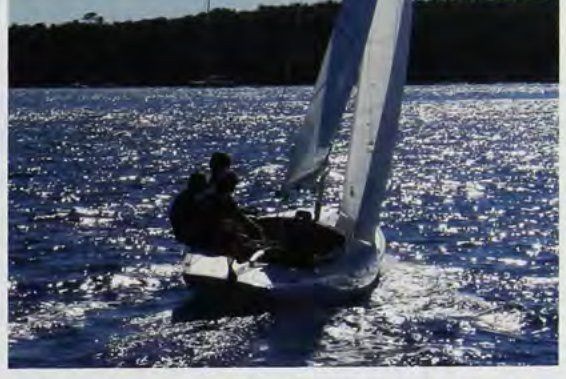
Knowing this, you can begin to think about when to best use the available acceleration. One way is to help further mitigate the slowing effects of a bad set of waves by first applying a fraction more helm than would otherwise keep a steady course and then releasing the helm just as the waves meet the boat. At this point you are in elbow-locked mode but the net helm is neutral and the boat is at its most willing.
Another application of this temporary ‘released’ state of the helm is that it frees up some valuable grey matter that would otherwise be designated to keeping the speed up. The time to concentrate the hardest is in fact when the boat is at its slowest and so conversely, when the tiller is in a released state, much less attention is required and the boat will find its own way. Knowing the boat is accelerating, the helmsman can take the opportunity to do any of those things which normally distract him, such as looking around at the competition or the more practised exponent will be able to perform complex tasks such as looking at a navigation chart or consuming some refreshment.
These few personal thoughts about the Dragon tiller raise many questions that are beyond the scope of this article or the competence of its author, but hopefully we can all aspire to higher levels of tiller awareness that we now know exist. The author fears, however, the inevitability of the day that the great Dane takes the tiller of an unfamiliar boat and asks “the rudder – is it blue?”
Originally published in the BDA Magazine 2006 Annual. © Graham Bailey and the British Dragon Association. Reproduced with permission.
← Back to the Technical Library