IDA Yearbook 2023 (2022 Review • 2023 Preview), pp. 20-21
↓ Readable PDF↓ Original pages (scan)
A practical guide to spinnaker trimming on Dragon runs, with tips from Werner Fritz, Pedro Andrade and Tim Tavinor. It starts with marking lines before racing: marks 1–2 cm in front of the cleat on sheets, pole uphaul and downhaul and halyard, and two backstay marks for the mast, which may go up to 50 mm forward at deck level downwind. For medium winds (5–16 knots) it covers full hoist, a pole perpendicular to the wind with both clews level, the windward barber raised, the mast fully forward, and easing the guy as much as a metre or more. It also explains sailing deep by the lee, lowering the pole in light airs, tightening both barber haulers in heavy winds to stop rolling, and gybing in heavy air with the runners on.
When you arrive at the weather mark in a good position it is easy to relax and think little will change on the downwind leg. With good spinnaker trimming and tactics it is possible to gain places and /or close the distance to the leader. Perhaps, even more importantly, if you arrive in a bad position, there are a lot of opportunities to improve your position. This article focuses on sailing downwind – not reaching.
When sailing downwind the primary objective is to maximise the surface area of the spinnaker that is presented to the wind.
There are a number of control lines and equipment that impact on the shape of the spinnaker and are involved in trimming:
- Spinnaker halyard
- Spinnaker pole uphaul (pole topping lift) and downhaul
- Barber haulers
- Mast position
- Sheet and guy (leeward and windward sheets)
How any of these are positioned will have a significant effect on the shape of the spinnaker and should be adjusted for different wind and sea conditions.
Preparation before you race
It is very helpful to mark all your lines when your spinnaker is up and flying in the correct position. Ideally do this when training in mid wind strength conditions. Marking sheets and halyards will make it much easier for the crew to quickly identify everything is in the right place when racing. Most racers prefer to make the marks on the sheets and halyards 1-2 cm in front of where they go through the cleat (i.e. they are very visible). Use a permanent marker pen and make the mark about 1 cm in length so it is easy to see.
Marking halyards and sheets
Mark the spinnaker sheets at the thin end that attaches to the spinnaker. This ensures you can always tie the sheet in the same position. One of the best and easiest methods for this is to place a ball behind a knot at the end of your spinnaker sheet (thin end). Then, when you attach the sheet to the spinnaker, make a loop, push it through the clew ring and then loop it back over the ball.
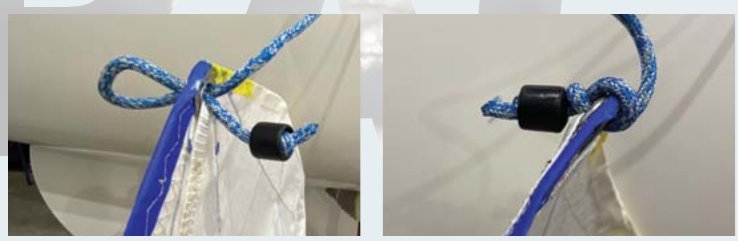
Once the spinnaker is up and flying with the pole in an aft position, mark the sheet near the cleat. Repeat this on the other gybe.
Mark the pole uphaul and downhaul when the pole is up and parallel to the deck.
Mark the spinnaker halyard at the full hoist position.
Mast Position
Under the Dragon Class rules the mast can be moved forward a maximum of 50 mm at deck level for sailing downwind. As the mast will require support in strong winds it is a good idea to identify and mark the backstay in 2 places – one for light to medium wind and one for heavier wind. In light winds the mast needs little to no support and can be allowed to have an inverted bend at the top (i.e. bent slightly over the foredeck). But as the wind increases it is necessary to support the top of the mast or it will break. The mast needs to be straight (i.e. forward but not inverted) in these conditions. So, mark the backstay and the coarse runners to show where this occurs.
Trimming – medium wind conditions (5–16 knots/2-8 m/s)
Spinnaker halyard
In practice hoist the spinnaker to its full height at the launch as this helps to stabilise the spinnaker at its top. Some of the sailors tie a knot in the halyard where it attaches to the spinnaker so that the spinnaker when hoisted is still 15 cm or so from the entry point into the mast allowing it to fly more easily.
Spinnaker pole
Hoist the spinnaker pole to a position parallel to the deck and tension the downhaul tightly. Always make sure the downhaul line is securely cleated before you hoist the spinnaker. If the downhaul is not cleated the pole will point skywards making it impossible to fly the spinnaker and potentially breaking the pole end. After the spinnaker is hoisted adjust the pole position aft so that it is perpendicular to the wind. You may need to loosen the downhaul to do this. Then adjust the height of the pole end to ensure the clews are parallel. Remember when gybing, you can ease the downhaul a little just before the gybe to make it easier for the foredeck to get the pole off and back on the mast
Barber haulers
In light to medium winds the windward barber can be raised so that there is a straight line from the barber hauler block through the pole to the windward spinnaker clew. This allows the spinnaker pole to be more stable. The leeward barber hauler should be loose and not cleated.
Mast position
The mast should be let forward to the maximum forward possible. Most boats have a mast ram system to push the mast forward at deck level and a system for tightening the genoa halyard to pull the mast forward at the top section. When these are tensioned, the mast won’t move backwards and forwards in the mast gate (at deck level) disturbing the spinnaker. Remember, as the wind increases, you will need to support the mast with more backstay and runner tension.
Sheet and guy (leeward and windward sheets)
The general rule is to fly the spinnaker with both clews at the same height. Once the spinnaker is flying you can adjust the height of the pole end to make this happen. The sheet needs to be played constantly; ease it until the windward luff of the spinnaker just starts to curl at the midpoint and the leeward sheet has pressure. It is not necessary to have the windward clew close to the pole end. The spinnaker will fly much more freely if you ease the guy sheet so that the clew is away from the pole end. Just how much will depend on the wind and sea conditions but in medium wind downwind it can be eased significantly – up to a meter or more. But note it is possible to ease the spinnaker too much and lose pressure in the spinnaker – take care.
“Going downwind, when you can’t see the clew on the leeward side, you can recognize the correct height of the spinnaker pole when the middle seam of the spinnaker is parallel to the mast, which means it’s vertical and both clews are at the same height.”
— Werner Fritz – Gold Cup and World Champion and owner of Fritz-Segel Sailmakers
Sailing deep
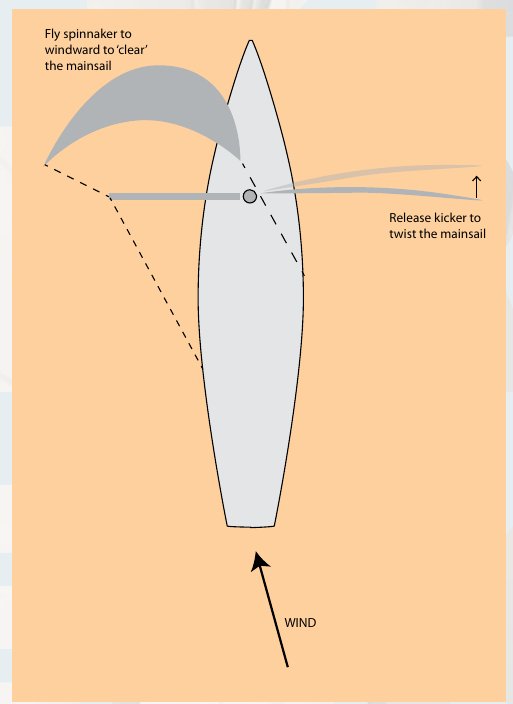
Sometimes you will need to sail deep (by the lee) for tactical reasons i.e. keeping clear air from other boats or avoiding the need to gybe.
“A good tip when sailing very deep is to fly the spinnaker as far to windward of the mast as you can to keep clear air and ease the kicker on the main boom. This allows the main to go as far forward as possible and twists the leech of the main resulting in a better air flow over the mainsail.”
— Pedro Andrade – European, Gold Cup winner and Commercial Manager, Petticrows
Variations for light winds
The main issue in light airs is keeping the spinnaker stable whilst maximizing the surface area to the wind. Most modern spinnakers work well if you lower the pole below parallel to the deck whilst trying to ease the guy sheet so that the guy clew is positioned above and in front of the pole end. As the wind increases and there is more pressure in the sail you can start to raise the pole again.
Variations for heavy winds
In heavy winds there needs to be greater control of the spinnaker or the boat will start to roll from side to side as it moves downwind. This removes a lot of forward energy. You can correct this by having both of your barber haulers tight and if needed tightening the leeward spinnaker sheet a little to move more spinnaker area behind the main
“Gybing in heavy wind: Sailing downwind in really heavy winds puts a lot of pressure on the top part of the mast. In light/medium winds it is viable to gybe with just the backstay on but in heavy winds you also need runners to support the mast. So, one possibility, is to have both crew in the cockpit during the gybe, one helping to gybe the main and the other letting off and bringing in the new windward runner as you go through the gybe. Once the main is gybed the foredeck can go on deck to gybe the pole. This maneuver requires the helm to keep the boat flat and dead downwind with a small alteration in course.”
— Tim Tavinor – World Champion crew and former owner of Petticrows.
Good luck and better speed.
Originally published in the IDA Yearbook 2023 (2022 Review • 2023 Preview). © International Dragon Association. Reproduced with permission.
← Back to the Technical Library