By Graham Bailey · BDA Magazine 2006 Annual, pp. 4-6
↓ Readable PDF↓ Original pages (scan)
Graham Bailey’s guide for visitors racing the 2006 Dragon European Championship courses in the central Solent. He points to the Bramble Stake weather station and the Winning Tides atlas, then summarises the tide: the ebb starts on the North shore about 2 hours 30 minutes before high water while the centre is still flooding, and the main race area east of the Bramble Stake sits in a slower ‘divergent’ zone. On wind, he describes the South West sea-breeze (often in before 10:30am at 10 to 12 knots, building to 18 to 22) and how to play westerly, easterly, northerly and southerly gradient winds, including Owen Parker’s rule “when the wind is in the North, go North”.
A visitor’s guide to racing the 2006 Dragon European Championship courses in the central Solent – essential advice from Solent ‘local apprentice’ Graham Bailey.
The Solent remains one of the premier racing venues in the world. The huge variety of available race-tracks have been enjoyed by club racers, championship and grand-prix sailors for many decades but few informative texts on central Solent racing exist.
This is most probably because gaining sufficient local knowledge is a lifetime’s work and those of us doing our apprenticeship there are likely to conk-out long before we are ready to publish our thesis on this most challenging subject. There are, however, certain tools available today which enable some degree of analysis that was not possible until recently.
Wind and tide resources
Some clever technicians have placed various instruments on the Bramble Stake which is smack bang in the middle of the Solent, and likely to be within 200 metres of the weather mark if we are racing in prevailing south-westerly winds. The instrument readings including current windspeed and direction, tide height, barometric pressure, sea temperature, air temperature and visibility, together with historical and archive data are all available on line at www.bramblemet.co.uk
Furthermore, the current data is also available via WAP-enabled mobile telephones by directing your WAP browser to www.bramblemet.co.uk/wap although of course this cannot legally be accessed by competitors during racing.
There are detailed tidal atlases available, the first I believe was researched by Uffa Fox some 70 years ago. This excellent work has only recently been surpassed by another bunch of clever technicians who have used the latest techniques to measure tidal flows for the entire Solent. These are available in (water-resistant) book form or electronically from www.winningtides.co.uk. One could attempt a descriptive prose on what the tide is doing but this is not now necessary in light of this excellent tidal authority which gives the ebb and flood speed and direction at half-hourly intervals.
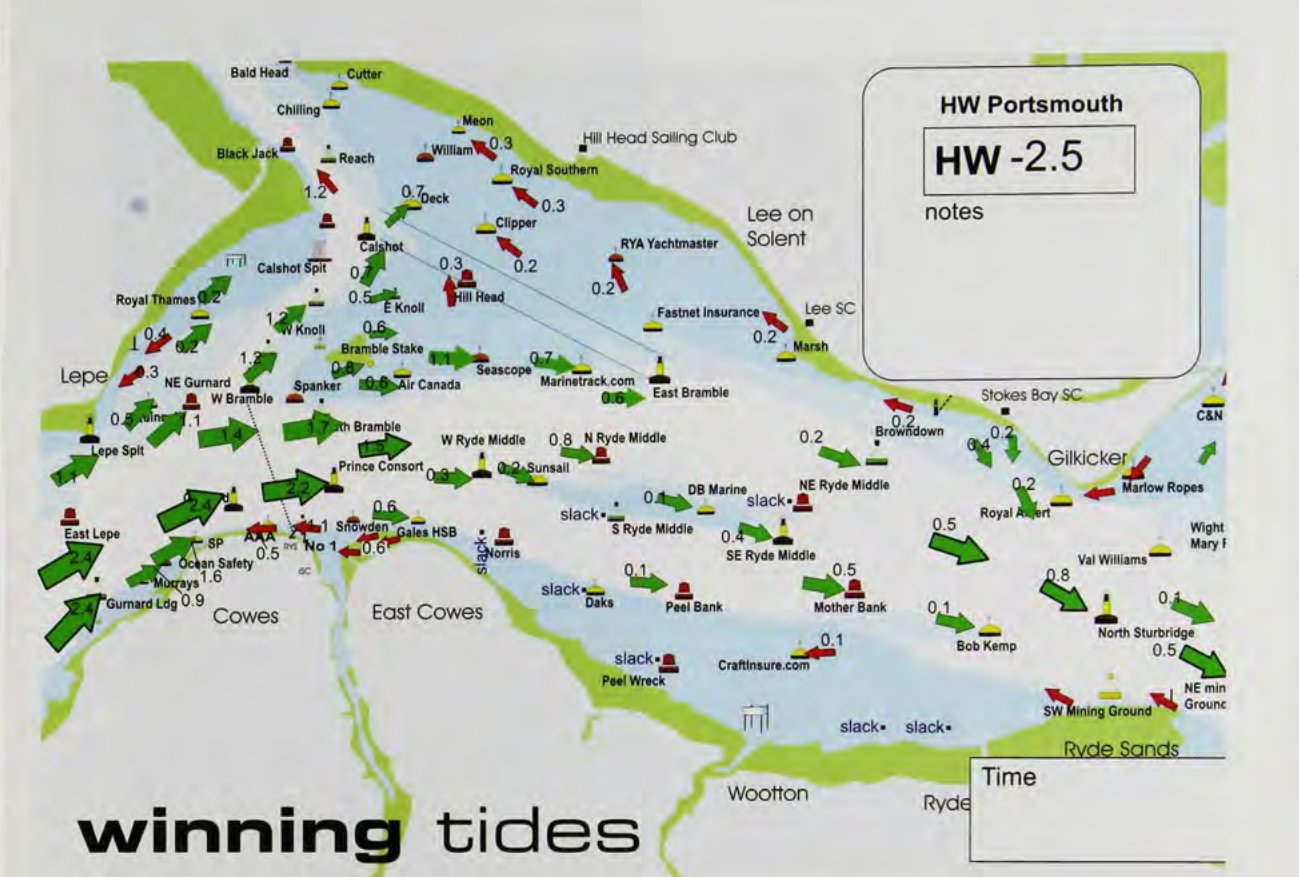
The electronic version has corrections for spring or neap tides plus many other features to help familiarise competitors with the various race tracks. Winning Tides have kindly allowed me reproduce a sample of their work for the purpose of this article and I have no hesitation in recommending their product to anyone intending to race in the Solent.
Tide
It may be helpful to briefly summarise the tidal considerations.
- The tide floods to the East and ebbs to the West.
- The ebb is stronger than the flood and so does not last so long, but apart from that the features of the flood are largely mirrored in the ebb with the exception of some local features, which are graphically represented in Winning Tides.
-
A flood tide when it reaches the central Solent will diverge and slow down. The main stream will continue fast down the South side of the Solent toward Portsmouth while the Northern stream heads up to Southampton.
It is this divergence which has created the Bramble Bank which famously dries out sufficiently at low springs to host a cricket match.
-
About 2 hours 30 minutes before high water, the ebb begins on the North shore and just off the Royal Yacht Squadron close to the beach heading West (see W-T chart opposite).
For a significant period in time therefore, the tide can be flooding in the centre and ebbing on the edges. This tremendous feature can be off-putting to the unfamiliar who may begin to think he will have no chance against the locally experienced sailors. The local sailors often like to think this too.
However, so often is this apparent advantage disproved by the free-thinking (blissfully ignorant) visitor that one must recognise ‘local knowledge’ as a fine balance between the advantage of knowing certain things and the burden of being caught out when they don’t happen as they did last time. This is the challenge for us local apprentices.
-
The main championship race track to the East of the Bramble Stake is in the ‘divergent’ zone, where the tidal flows are significantly slower than those in the main channels. So tide is less of a factor and a clever race officer can position the track to give balanced choices between the two sides of the beat.
There is a channel running through this area for smaller tonnage to get to and from Southampton without going the long way round the West side of Bramble. This is marked on the W-T graphic between Calshot and East Bramble.
- Heading West from the mainland shore at Lee-on-the-Solent, the sea bed shelves gently before reaching maximum depth in the North channel and then becoming shallow again on the Bramble Bank.
- Fortunately for us, the RYS race management team is one of the most experienced around and they will know precisely where to position the track for the fairest and best racing.
Wind
Sea-breeze
A few words then about the wind. Early June will have some potential for sea-breeze generation. The signs to look out for are a strong sun and bubbly cumulus cloud appearing over the mainland shore to the North and North East. The main sea-breeze direction is from the South West. It can arrive quite suddenly. On a good sea-breeze day, the wind will come in before 10:30am at about 10 to 12 knots from the South West and then build to about 18 to 22 knots or sometimes more. On a less good sea-breeze day, the wind may not come in until 3 or 4pm.
There is an alternative sea-breeze direction. It can come in from the South East. It is possible to have the two different breezes competing against each other with the South Easterly starting first. The South Westerly usually wins those contests but quite often, there can be very little wind in the central Solent until their differences are resolved.
Early June is not likely to be dominated by these features but if they manifest during the morning, we could not have a better race team to anticipate and judge where our track should be to make best use of the conditions.
Aside from sea-breezes, the main features of the gradient driven winds are as follows.
Gradient winds
Westerly
The South Westerly is the most common wind direction. This is a relatively stable direction and will allow for a long windward leg to be set commencing near the Lee-on-the-Solent shore, with the weather mark placed on the Bramble Bank. In this scenario, if the start line is sufficiently close to the lee shore, the tidal flow will be parallel to the shore, then further up the beat, it will be closer to the direction of the wind.
Watch out for the cross-tide start line therefore, and keep a look out for any shipping using the North Channel which we are likely to cross about a third of the way up the beat.
Left, right and middle options are always available on this track but if the windward mark is placed to the left of the Bramble Stake looking upwind, there is a tendency often for the left to come out ahead in both a flood and an ebb tide.
Conversely, if the weather mark is to the right of the stake, then the right can do well. It all depends on where the mark is placed. It may be that we don’t get within half a mile of the Bramble stake but if we do and the mark is positioned to the left, it will be in deep water so while the left side can come out ahead, the final approach on a flood tide should be from the shallows at the top right. The ebb is less critical.
Down the run, remember the tide will be parallel to the lee shore, if the mark is close enough so if we are in a full flood, it is easy to say “let’s go down the South side of the run for maximum tidal stream”. But then the tide curves towards Portsmouth as the lee-shore approaches and the danger is that before you know it, you have sailed beyond the port layline to the mark – classic and common error here which we continually re-learn.
Easterly
Easterlies are common also. A typical Easterly will feature blue skies and a slight haze. If we get this, these winds are very stable and straight. The track is likely to be set to the East of the North Channel and if the wind is to the South of East as it often is, the leg will be almost parallel to the mainland shore. The tide is straightforward, with less inshore and more offshore, but be aware that within 2 hours 30 minutes of HW, the tide on the shore will turn first.
Wind wise, there tends to be more wind nearer the shore in this direction so left for the wind is generally good but right options counter-balance this in a flood tide. The ebb tide will be more of a left game – you will find the locals on the left but I have already observed Ho-Jo coming in from the right with a 30 yard advantage so this is not a golden rule.
Northerly
“When the wind is in the North, go North”. These famous words were uttered by Owen Parker who skippered Ted Heath’s Morning Cloud in the 1970s and have crystallised into Solent lore.
It took me several seasons to work out what he meant because if the wind is in the North, you go North in the same way as if the wind is in the West, you go West – I thought.
What I think he meant is this – if the wind is anywhere in the Northern sector, take the tack nearest the North first. If the wind is North West, then get onto port or if it is North East, stay on starboard.
In both scenarios, the wind is unstable but the big gains are with gusts that come straight down Southampton Water. A North Westerly will veer in those gusts, so if you have done your port tack early, you will have a nice right-hander with increased pressure to come back to the middle. Conversely a North Easterly will back, so if you headed left, you will be on a nice pressured-up port tack back to the fleet.
Apart from Owen’s rule, the other thing to look out for is that if the track is set parallel to the Lee-on-the-Solent shore, ie the opposite way to the South Easterly above, there is likely to be less wind near the shore. That is not to say that the left will always come out ahead however, since right shifts are regularly dished out nearer the shore. This is truly a direction for staying offshore, taking the shifts and keeping your head when you see the big right-handers on the other side of the beat.
Southerly
Southerlies occur less frequently but when they do, they are also reasonably shifty. Owen’s rule has no application to this reverse direction. In fact it is more the case that if the wind is in the South, go East or West. Generally, the wind in the Western Solent will be more West and conversely, the wind in the Eastern Solent will have more East. Either corner could pay therefore depending on placement of the weather mark, so watch out for Ho-Jo coming out of the middle.
Summary
We have only scratched the surface of this topic with a few thoughts to get your head around the central Solent race track, which I hope will not have polluted the minds of the free-thinking visitors.
Winning Tides is available online at www.winningtides.co.uk (where there are also electronic versions, with various enhancements). The book is also available price £26.90 from Pascal Atkey, Cowes High Street, near the Red Jet fast ferry terminal.
Originally published in the BDA Magazine 2006 Annual. © Graham Bailey and the British Dragon Association. Reproduced with permission.
← Back to the Technical Library