By David Dellenbaugh · BDA Magazine 2004 Annual, p. 25
↓ Readable PDF↓ Original pages (scan)
A Rules Corner piece explaining the racing-rules concept of “proper course”: the course a boat would sail to finish as soon as possible in the absence of the other boat(s) referred to in the rule. Dellenbaugh explains why a proper course is subjective and constantly changing, that there is none before the starting signal, that only three right-of-way rules mention it (17.1, 17.2 and 18.4, numbering of the rules then in force) and that none requires you to sail it. He also notes that a proper course need not point at the mark, has nothing to do with speed, and may not take account of the windward boat’s bad air when you are the leeward boat.
If you want to know your rights and obligations when you’re near other boats on a reach, it’s important to understand the concept of proper course. Your proper course is defined as the course you would sail in order to finish as soon as possible (see box below).
To figure out your proper course, you must take into account a number of strategic factors including wind speed, wind shifts, current, waves, your boat’s performance, the position of the next mark, the presence of other boats, and so on. By considering what may happen with each of these factors in the near future, you make your best guess about where you should steer to get to the finish line fastest. This is your proper course.
Definition: PROPER COURSE
A course a boat would sail to finish as soon as possible in the absence of the other boats referred to in the rule using the term. A boat has no proper course before her starting signal.
The flexible nature of proper courses
By definition, a proper course is subjective. It’s based on your own opinion about a complex set of variables, and this means several things: First, since it’s unlikely that two sailors would come up with exactly the same solution to those complex variables, almost every boat will have at least a slightly different proper course (even when boats are identical and very close to each other on the race course).
Second, since the wind, current and other variables are always changing, and boats are constantly moving, your proper course is always changing too. The fastest course to the next mark at one moment may be entirely different a few moments later.
And third, a proper course is seldom black or white. Any course that you can reasonably justify as being the fastest way to get to the next mark could be considered “proper.” For this reason, it’s often difficult to figure out if other boats are sailing their proper course or not. As far as the rules are concerned, sailors usually get the benefit of the doubt on this unless they are obviously sailing a course that won’t get them to the next mark quickly.
More thoughts about proper courses
Here are some other things you might need to know:
- There is no proper course before the starting signal. Since you aren’t going anywhere before the start, you can’t have a course that will get you there as soon as possible. At the moment the gun sounds, however, you begin to have a proper course, even if you haven’t yet started (i.e. crossed the starting line).
- It is possible – even likely – that you may occasionally have more than one proper course. When you are sailing upwind, for example, there are times when both tacks will appear equally advantageous. In that case, your proper course could be closehauled on either port tack or starboard tack.
- There are only three right-of-way rules that mention proper course (17.1, 17.2 and 18.4). None of these rules ever require you to sail a proper course, though there are times when you can’t sail above it and other times when you can’t sail below it.
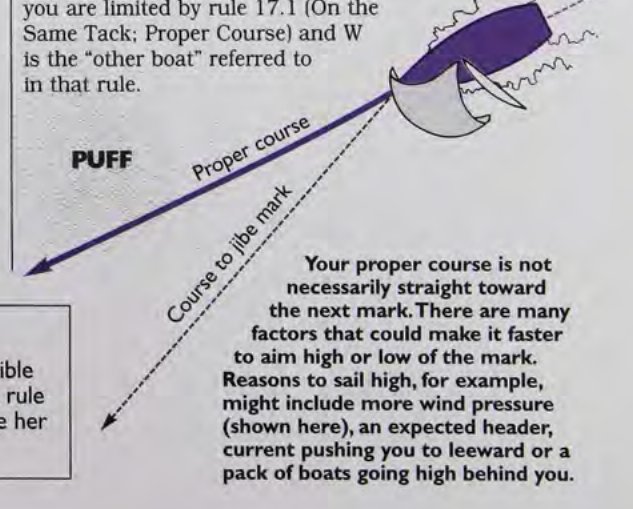
- One common misconception is that you must be aiming right at the next mark in order to be sailing a proper course. That is incorrect since you may need to steer high or low of the mark due to current, changes in the wind and so on. And on a beat or run you usually can’t aim right at the next mark because of tacking and jibing angles.
- The concept of proper course has nothing to do with speed. When you are sailing a proper course it doesn’t matter how fast you are going – it only matters where you are steering.
- When determining your proper course, you can factor in any possible variable (wind, current, etc.) except for one. The only thing you can’t consider is the position of “the other boats referred to in the rule using the term.”
Pretend you are sailing down a reach on starboard tack, for example, and you establish a leeward overlap on another starboard tacker. Your proper course is the course you would sail to reach the next mark as fast as possible if the windward boat (W) wasn’t there. You can’t include the bad air of W in your proper course calculations because you are limited by rule 17.1 (On the Same Tack; Proper Course) and W is the “other boat” referred to in that rule.
Originally published as “Rules Corner – When is your course “proper”?” in the BDA Magazine 2004 Annual. © David Dellenbaugh / Speed & Smarts, reproduced in Dragon News by permission. Reproduced with permission.
← Back to the Technical Library