By Anthony Shanks · BDA Magazine 1994 Christmas, pp. 12-13
↓ Readable PDF↓ Original pages (scan)
Rule numbers and wording as of 1994 (the IYRR then in force; today's Racing Rules of Sailing are numbered differently). Anthony Shanks, a Dragon crew training as an RYA National Judge, uses incidents from the 1994 Dragon South Coast Championships to explain two rules that caused most disagreement: rule 39.3, which bars a windward yacht within three lengths from sailing below the leeward yacht's proper course, and rule 42.1, which gives inside overlapping yachts room at marks. He shows why boats approaching a leeward mark wide from the starboard side are exposed to many overlap claims once inside the two-length circle, and how tide bunched some 30 boats into a line at the mark. He urges competitors involved in collisions to protest, since in a third-party protest only the collision, not the circumstances, has to be proved.
Anthony is a regular Dragon (and Etchells) crew, based on the South Coast. He is currently reading Maritime Studies at Southampton Institute and is working to become an RYA National Judge.
When asked to write a short article on rules for this newsletter I was unsure where to start. I therefore decided to capitalise on my experiences on the water this summer, and the obvious holes in people’s interpretation of the rules on the water. Quite often people are able to quote rules but are unable to interpret them. To illustrate my point I will use a combination of two specific rules over which I saw much disagreement this summer, particularly during the unforgettable mark roundings at the Dragon South Coast Championships last May.
Rule 39.3 Sailing below a proper course
A yacht on a free leg of the course shall not sail below her proper course when she is within three of her overall lengths of a leeward yacht or of a yacht clear astern that is steering a course to leeward of her unless she bears away and gybes onto another proper course without interfering with the other yacht.
Note: Definition of proper course.
A proper course is any course that a yachtsman might sail after the starting signal in the absence of the other yacht or yachts affected, to finish as quickly as possible …
The rule clearly states that a yacht may not sail below her proper course when she is to windward and within three boat lengths of another. If we look at this carefully then we see that she may not sail below the proper course of the leeward yacht, since it is this yacht that dictates the proper course. Should the windward yacht not agree with the leeward yacht’s proper course the only come back that she has is to protest. She may not bear away towards the leeward yacht under any circumstances. She may bear away to gybe if the leeward yacht is not interfered with.
Even if a boat is clear ahead of another she is not allowed to sail down towards the course of the other yacht if its course is to leeward (see Figure 1).
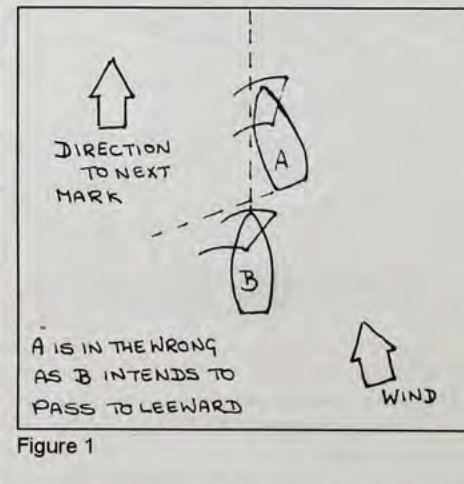
This rule is one that leads to more acrimony on the water than almost any other. With the introduction of more windward/leeward courses it is also one that is liable to be invoked more than ever.
The conclusions I reach over this rule are that if you are the windward boat all you can do is try and convince the other boat of his folly in the choice of his proper course. If this does not work you can try and protest but this is one of the rules which is almost impossible to win in the protest room. At no stage may the windward boat bear down towards the leeward boat!! If you are the leeward yacht then you can, within reason, sail anywhere that you desire. Perhaps the biggest mistake that people make is to gybe too close to the other boat, thus contravening the last part of the rule. If you are going to gybe at least give yourself room to complete your gybe, and from the moment you have completed your gybe, and only then, must the other boat take avoiding action (explained in rule 41.2 Changing Tacks – Transitional). This distance varies enormously with the weather conditions.
Rule 42 Rounding or passing marks and obstructions, notably Rule 42.1 When overlapped
a) Except as provided in rule 42.3, an outside yacht shall give each inside overlapping yacht room to round or to pass the mark or obstruction, including room to tack or gybe when either is an integral part of the rounding or passing manoeuvre.
Note: Definition of overlap
A yacht is clear astern of another when her hull and equipment in normal position are abaft an imaginary line projected from the aftermost point of the other’s hull and equipment in normal position. The other yacht is clear ahead.
The yachts overlap when neither is clear astern, or when, although one is clear astern, an intervening yacht overlaps both of them.
The terms clear astern, clear ahead and overlap apply to yachts on opposite tacks only when they are subject to Rule 42 …
This rule is in essence a remarkably simple rule, but leads to much disagreement owing not to differences in interpretation, but differences in opinion. I would like specifically to look at the leeward mark, which during the Dragon South Coasts was the point on the race course that led to more incidents than any other mark.
When approaching the leeward mark, for a port rounding, after a run, boats that are coming in from a wide angle on the starboard side of the course are exceptionally vulnerable. When the two boat length circle is entered their wide approach means that everybody, their relations and almost anyone that happens to be on the water have the right to ask for water, since the projected line from their stern stretches up the race course (see Figure 2).
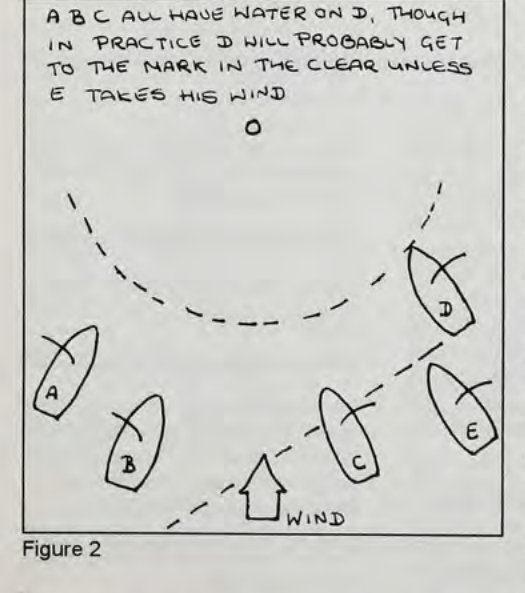
During the South Coasts the effect of the tide on the runs bunched the best part of 30 boats into a line. When they all arrived at the mark the boats on the outside were hailing “no water” when there was no possible way that they had entered the two boat length circle. The inside boats were calling for water when there was absolutely no chance of water being given. Only one or two boats came out of this melee in a better position than when they started, usually the ones that took the long course round the outside and the one boat that could get round on the inside and put everyone else in his dirt. Whilst this was happening there was an unacceptably high number of collisions, none of which are minor and unavoidable until the protest committee decides so.
This situation is one that is unique to tidal areas, but we do most of our racing in such areas. Although many may view the collisions as unavoidable they should go to protest if only to be absolved from the necessity of a third party protest. Such a protest can result in the disqualification of all the boats involved in the collision, which in one race during this regatta could have been anything from two to twenty, since in a third party case it is only necessary to prove a collision, not the circumstances.
Originally published in the BDA Magazine 1994 Christmas. © Anthony Shanks and the British Dragon Association. Reproduced with permission.
← Back to the Technical Library