By John Heyes · BDA Magazine 1994 Christmas, pp. 8-10
↓ Readable PDF↓ Original pages (scan)
John Heyes sets out five starting skills – measuring line bias, choosing an end, taking a transit, creating and protecting a gap to leeward, and time-on-distance judgement – and a pre-start routine that begins at least an hour before the gun. He shows how to measure bias by taking a bearing along the line and comparing it with the wind direction plus 90°, and how much it matters: with 5° start a third up from the favoured end or ignore it for a favoured side, with 10° start a third up from the pin, and with 15–20° start right at the pin. Two worked situations cover parking on the line with a 10° port bias (allowing 30–40 seconds to reach full speed in 8 knots) and a light-air, foul-tide start at the committee boat, followed by advice to sail low and fast off the line rather than pinching.
John spent 6 years as One Design Manager for North Sails; he now works for Yachts and Yachting and is our Promotion Officer. He has successfully competed in numerous Dragon Regattas including 6 Edinburgh Cups.
Starting in the right place and going the correct way in the opening minutes of a race used to be a complete mystery to me. Then I learnt how to work out which end of the line was favoured, and which are the most important factors at the start. There can be little point in starting right at the leeward end to take advantage of a 10° bias if there is a major tidal advantage, or persistent shift out on the righthand side of the course which you cannot get to because you are trapped on the left.
For the aspiring Dragon sailor there are five starting techniques which need to be learnt and understood in order to consistently pull off a good start:
- Calculating the extent and direction of any line bias.
- Deciding which end to start, taking into account line bias, tidal strength and direction of likely wind shifts.
- Select a transit to ensure you know exactly where the line is.
- Positioning your boat on the line, creating and protecting space to leeward.
- Time on distance judgement, so that the boat accelerates at the right time to hit the line at full speed.
Pre-start routine
At a couple of Dragon regattas I have been nearly caught out by the Race Officer setting his line and beginning the starting sequence very quickly, with the pin end buoy going down after the ten minute gun. (It must be in place before the 5 minute signal.) Be aware that some Race Officers like to start on time and the fact that most of the fleet are tuning their boats halfway up the beat will not deter them.
Aim to arrive at the starting area at least an hour before the start. Immediately sail up wind, set the boat up for the expected conditions, track the wind and monitor the tide at any marks. It is worth sailing out to both extremes of the beat to see if there is any marked difference in the wind direction and strength. Is there a wind bend as you sail in towards the cliffs, as you often find at Abersoch or on the Clyde’s ‘East Patch’? Are you headed as you sail out to sea and is it sunny enough for a sea breeze to fill in? As you run back down to the start with 30 mins to go, the crew should be discussing what they have found and making a decision on which way to go up the first beat, irrespective of any line bias.
A typical conversation, racing at Lowestoft, might be: “Well it looks like a sea breeze may come in, the sky’s clear, it is getting hot and it was forecast, do we want to head for the right?” “Yes, but there will be less tide against us on the left. Which is more important?” “Hopefully most of the fleet will know about the tide and want to take a long tack into the shore; if we start to windward of the fleet and go towards the left we will be on the right side of the fleet if the breeze flicks to the right, we should get more wind there too.”
With your race plan taking shape get back to the line before all the other boats do. Then you can get a clear bearing on the line and pick a transit with a feature on the shore if possible.
In a Dragon, it is relatively easy to position the boat exactly on the line. Align the forestay with the pin buoy and the backstay with the mast on the committee boat, whilst sighting the compass on the centreline. (See photos.)
Calculating the bias
A competent Race Officer will tend to set a start line with a 5°–10° port tack bias, in order to encourage the fleet to spread out along the line. If there is a good reason for going right up the beat, such as a major tidal benefit, the port end bias may be more, to tempt crews away from piling up at the committee boat end.
Occasionally there may be a starboard end bias if the left hand side of the course is heavily favoured. However, in a shifty breeze the bias can frequently change and may not end up as the Race Officer intended.
In my experience, it is vital to know how much bias there is on the start line. The only way to measure it is to take a bearing along the line, then measure the wind angle, add 90° to that and see if it is more or less than the bearing of the line. (See diagram.) All the other methods you will read in the textbooks, such as reaching down the line with the main cleated, etc., will tell you which is the favoured end, but cannot tell you by how much.
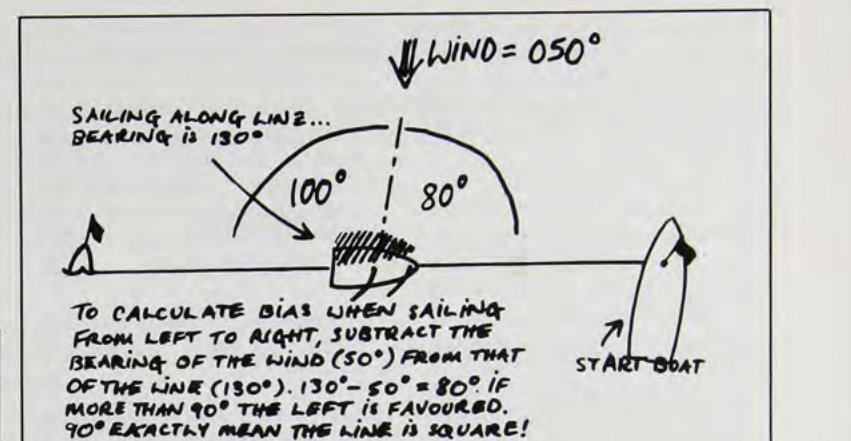
Your starting position on the line depends on the degree of bias. If there is only 5° it would be good to start a third up from the favoured end, but maybe you wanted to go up the opposite side for the beat. Forget the bias and start at the other end in order to take that side of the course. When a line has 10° of bias you have to take it seriously and position the boat towards that end. Starting a third up from the pin is usually favourite as you miss the scrum right at the mark.
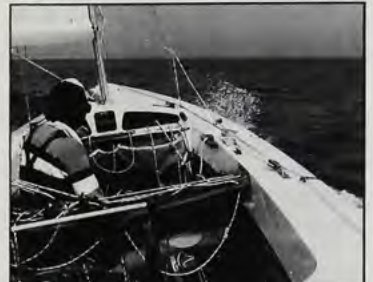
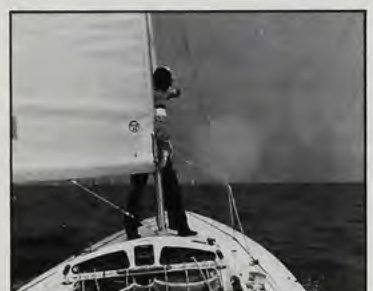
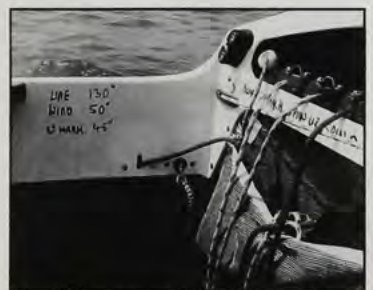
Occasionally you will find a bias of 15°–20° or more, either due to a major wind shift just before the start, or a blind Race Officer! In this case it can be true to say that whichever boat starts right at the pin will be among the leaders around the windward mark. With this amount of bias there is only one place to start.
Starting techniques
Situation 1: 10° port end bias, left side of the beat is favoured, 10 knots true wind
Here the aim is to start a third up from the pin, create a gap immediately to leeward in which to bear off and accelerate just before the start. With 1½–2 minutes to go sail up the line from the leeward end towards the fleet, the majority of whom will be reaching down on starboard. Tack just before they reach you and luff slowly so that the bow is just on the line. The transit you took earlier is vital now to tell you exactly where the line is. There is now 50 seconds to the start. The bow is pointing 10° off the wind, the sails are well eased out and flapping. The rest of the fleet is now reaching down at you with alarming speed. One of the crew (not the helmsman, who should be concentrating 100% on his position and timing) starts to shout at the rapidly approaching boats, “Up, up, keep clear”. Other crews should abide by your call and slow up or luff to keep clear to windward. (Remember IYRR 40 requires any luff before the start to be slow and allowing the boat to windward room and opportunity to keep clear.)
With your boat now parked on the line, the fleet to windward will all have to slow down and stack up above you, or bear off and duck the boats to leeward. The remainder of the fleet to the left will carry on reaching down the line for the pin, leaving a gap to leeward. If there are other boats close by to leeward doing the same thing, you must hold your boat still on the line until they sail away down the line, without letting any of those above you sail over the top.
Now, depending on the wind strength, the helmsman has to choose his moment to bear off into that gap he has created to leeward, allowing enough time for the boat to accelerate to full hull speed before the gun. At 8 knots in a Dragon this could take between 30–40 seconds. If there is a large gap to leeward and no danger of arriving at the pin too soon, you obviously have more time and room to build up speed. The larger the fleet and the shorter the line the harder it is to create the gap, but if you do not leave room to build the necessary speed the fleet will simply reach over your boat and leave you standing and wondering where it all went wrong.
The vital skills here that your crew needs to develop are:
- holding the boat on station without sliding to leeward and
- time on distance judgement, so that you do not accelerate only to arrive at the pin with 10 seconds to go.
The problem many mid-fleet sailors encounter when trying to stop the boat dead on the line is that they let the sails right out but keep the bow down and end up sailing into the gap they have just created. The technique is to turn the boat sharply into the wind, push the boom out hard to stop going over the line and even sail backwards if necessary. However, once stopped return the bow to 10° off the wind with the sails right out. If you keep the bow into the wind there is a big danger of getting stuck head to wind at precisely the moment when you need to sheet in and get moving.
Despite positioning your boat perfectly for the start, there will always be those around you who either do not know exactly where the line is or get excited and start pushing over the line too soon. Once another boat goes over the top of you and interferes with your wind it is all too late. The only way to avoid a premature starter ruining your start is never let him get there in the first place. Enthusiastic and slightly aggressive shouting can deter the cowboy starter from getting too close to you in the last few seconds but if he is determined to start early there is not much you can do. Be careful that your cries of “Up, up,” etc. do not force the other boat over the line into your path. Rather try and psyche the opposition into not daring to sail over your boat.
If boats on both sides start to go early and their sails are hiding you from the eagle eyed Race Officer, then keep level with them and go forward with the pack. The chances are that it will be a general recall, but if it is not and you are left three lengths back, but on the right side of the line, that top 10 position at the windward mark will be out of the window. But, do make sure you are hidden if you decide to go early. The occasion to wait back and let the cowboys go is when the black flag is flying.
Situation 2: 15° port end bias, 6 knots true wind, 1½ knots of foul tide
In this case (taken from the Edinburgh Cup), it was vital to take the bias and start under the committee boat, as the light breeze was likely to shift to the right. However, with a 45′ committee boat, little wind and a sluicing tide, sailing up inside was impossible. The crucial point in a light airs start is to keep speed on the boat the whole time and come in to the line later than the rest, with maximum speed, and cruise over the top of the slowing boats which arrive too early. With so much tide we had to keep above the line and decided to duck down at the last minute from over the line, picking up full speed to hit the line at the gun. The other big benefit of starting near one end or the other in light airs and foul tide is that it is a lot easier to judge the line accurately and less distance to sail round the ends if caught over early.
With 20 seconds to go we bore off from above the committee boat, ducked the line, sheeted in and crossed the line at full speed. After 10 seconds I looked back to see a pack of boats crawling around the back of the committee boat, with no speed, yet to cross the line. We rounded the mark 3rd and went on to win the race.
At the gun
Many Dragon sailors think that the thing to do as the gun goes is to sheet in hard and try and sail as high as possible. I used to do this and wondered why the boats either side would soon sail over the top and leave us sitting in the whole fleet’s dirty air. In fact you should sail low out of the start, down into the space you previously created, in order to build speed quickly. As the Dragon reaches hull speed the keel becomes more efficient in generating lift and so it is then much easier to gain height to windward. Obviously height is important after the start, but do not try and point high too soon. Conversely you cannot afford to bear off underneath another boat and if someone does start too close to leeward you will have to struggle to keep him above you after the start.
There will always be bad starts when for some reason you do not get away in the front rank and in clear air. When it happens you must instantly look to see the earliest opportunity to tack off under the fleet to get to clear air. The sooner you can tack the less you will lose, even if it means dipping many transoms.
This can only be a brief look at the many methods of starting, which will always vary as the priorities of each situation dictate. Some helmsmen like making a pin end start by using a timed run from the committee boat; others in a shifting breeze will sit in the middle of the line until two minutes, then choose an end and sail towards it.
Once you have learnt to prioritise the most important factors of a start, the choice of where and how to make that start will rapidly improve. The confidence and satisfaction from getting it right is the ideal boost to help get your Dragon around that windward mark first.
Originally published in the BDA Magazine 1994 Christmas. © John Heyes and the British Dragon Association. Reproduced with permission.
← Back to the Technical Library