IDA Yearbook 2020 (2019 Review • 2020 Preview), pp. 28-30
↓ Readable PDF↓ Original pages (scan)
Maintenance tips gathered by the IDA from Dragon experts at Petticrows, North Sails, Fritz Segel and Kate Cole, in three parts: checks during the season, boat handling while racing, and winter maintenance ashore. In season, rinse everything with fresh water, check the forestay at the masthead, the gooseneck, ram area and boom fittings, keep the battery charged and its connections greased, clean the pump impeller, and lubricate blocks and cleats with a non-oil lubricant. Since most mast breakages happen at the ram, it gives the safe order: going downwind, release the ram before the runners; going upwind, ease the genoa tension, pull the mast back with runners and backstay and only then pull the ram back. For winter it covers washing the hull, supporting the mast on at least three supports, storing sails flat with battens slackened, and four trailer checks.
We have all been there – losing a race or having to retire because of avoidable gear failure on the boat. But you can significantly reduce the risk of this happening with regular visual checks and good boat maintenance both during the sailing season and when the boat is ashore stored for the winter. In this article we have asked a number of Dragon experts for some tips on keeping your Dragon breakage-free.
The advice is organised in 3 sections:
- Checks and maintenance during the season
- Boat handling when sailing
- Winter maintenance
Checks and maintenance during the season
Sailing competitively means your boat is under stress. If you are sailing in saltwater you are also vulnerable to corrosion and your equipment sticking from a build-up of salt. So, the golden rule is to check your equipment regularly and rinse the boat thoroughly with fresh water at every opportunity. But let’s look at some key areas in more detail.
Mast and Boom
Check the mast whenever you take it down. Most of these checks can also be done when the mast is up. The mast takes a lot of strain during racing particularly in the following areas so check these for cracks, corrosion or loose fittings
- Gooseneck – where the boom attaches to the mast
- Mast Ram (Mast Pusher) area
- Boom – where the kicker and mainsheet blocks attach to the boom
Forestay, Backstay, Runners and Rigging
The forestay is the most important part of your rigging to check. Every time you take the mast down check it for signs of wear, particularly at the top of the mast (see photo). It is relatively easy to fix a forestay before it breaks but very hard after! Also check the forestay fitting above and below the deck during the year to ensure it is straight and not damaged. If the forestay is damaged or out of line in any way you will probably have difficulty pulling out the genoa when you need it most.
Regularly pull the bottom ends of your backstay and runners through the deck (still attached) and examine them for signs of wear as they can rub where the ropes (wire) go through the deck.
Ropes and Shockcord
Ropes and shockcord (elastic ropes) should be checked during the season for signs of wear. Also examine the ropes for the Cunningham, Kicker and Boom Outhaul as these can easily fray if led incorrectly through the gooseneck fitting or if they rub against a ring or shackle.
Battery & Pumps
The battery and box take a lot of punishment and are often under water. It is vital to frequently check them. Keep the battery charged and do not leave it on the boat for any period of time. Grease the electrical cable to battery connections regularly with a product like Vaseline (petroleum jelly) and when you are not using the boat for a week or more disconnect all the plugs from the battery box and make sure they are hanging where they will not come in contact with water. This will help prevent corrosion of the terminals.
Several times a season remove the pump from its sailing position and clean any debris from around the impeller shaft. While you are down there remove any rubbish from the bilges – you will be surprised what you will find – sunglasses, money, bottle tops, cable ties….. Fill the bilge with clean water and then use both the electric pump and manual pump to remove it (this will flush them through with clean water).
Spinnaker Hatch (if you have one)
Put silicone grease on the spinnaker hatch tracks to keep the hatch opening and shutting easily.
Blocks Cleats & Tracks
Whenever possible use fresh water to rinse the entire boat paying particular attention to cleats and fittings. There is really no substitute for holding a water hose to all your tracks, cleats, cars (especially the mainsheet car) and blocks. Whilst you are hosing them use the ropes to move the blocks, move cars back and forth and open and close the cleat jaws to ensure that all parts are clean. You will immediately start to feel them moving more easily. You should lubricate all cleats and blocks with a non-oil based lubricant like McLube One Drop or Holt Prolube.
Hatches & Bungs
Whenever the boat is ashore open all the hatches in the hull to “allow the boat to breathe”. Examine any hatch clips (see picture) or fittings to ensure they are still closing the hatch tightly. For more information on maintaining hatch clips go to www.petticrows.co.uk.
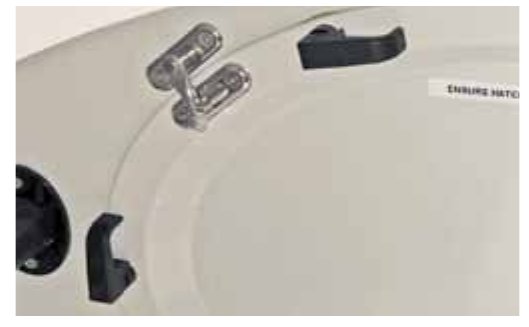
Remove the bung above the keel to allow water to drain from the bilges and keep the boat dry.
Sails
Any sail will last longer if it is taken care of.
Whenever you have the opportunity rinse your sails in fresh water but remember to thoroughly dry them. If you roll your sails when they are still wet with fresh water you will get mould on the sail. So dry them well!
Both the genoa and mainsail should be carefully rolled and stored flat in a dry place.
Take spinnakers ashore, wash, dry and store them in a bag that is big enough for the spinnaker to fit without being crushed or creased. Do not put other items on top of the spinnaker bag.
Boat handling during racing
Good boat handling will massively reduce the potential for damage. The most common mistakes that we see on the racecourse are:
Forestay
When you are rolling or unrolling the genoa always have tension on the forestay, this helps to protect the furling gear and forestay.
Mast Ram (Mast Pusher)
The majority of mast breakages happen in the ram area and are the result of not using it properly. If you follow the correct sequence you will significantly reduce the possibility of mast failure.
When going down wind, first let off the mast ram and then release the runners to let the mast go forward.
Before going upwind, let off the genoa tension string (called the f-ulator), pull the mast back using the runners and backstay and only then pull the ram back.
Jumpers
In heavy airs you may have the jumpers off upwind to depower the mainsail, put them on again before you go downwind so that when you gybe with only the back stay on, the top part of the mast is supported.
Rings, pins and shackles
Check all rings, pins and shackles. It is a good idea when rigging the boat to tape over shackles, pins and rings to ensure they do not open up or catch on ropes, sails, etc
Sails
When you are sailing take care when you roll the genoa. The window in the sail can break if it is rolled with a crease in it. This is not fast!
Regularly look at the tell-tails on the main and genoa and remove any furry parts as they will prevent the tell tails flying properly.
Winter maintenance – on shore
Hull
Wash the boat both inside and out with a mild detergent before putting it away for the winter. This will help remove any salt residue and reduce corrosion.
Battery
Take the battery out of the boat and store in a dry place.
All removable ropes
Wash and store in a dry environment.
Mast storage
After washing and leaving the mast to dry, lubricate all moving parts. You can buy special marine products to wipe onto the mast which will protect it during the winter.
When a mast is down, make sure it is adequately supported along its entire length – a minimum of three supports is good. If you are leaving it on top of your boat on the trailer mast supports loosen any strings tying the mast to the supports so that the mast is not under any strain. If the mast is outside with a mast cover make sure the zip is facing down to prevent water getting in.
Sails
Sails should be washed and stored dry on a flat surface. It is worthwhile releasing the battens in the main by taking the battens out of the batten pockets on the leech. You don’t need to remove them, just take the pressure off. We recommend rolling genoas and mains and storing them in dry place. It is also worth applying WD40 (or equivalent) to the zip on the genoa to reduce the possibility of corrosion over the winter.
Store your spinnaker inside as mice are known to use spinnakers to make their nests!
Trailer
Surprisingly many sailors forget about looking after the trailer over the winter. There are a few simple things you can do that will help your trailer last longer.
- Give all the trailer electrical connections a quick spray of WD40 and then grease with Vaseline or equivalent to reduce the risk of corrosion
- Grease (with a heavy grease) either the tow hitch ball on the car or the tow hitch fitting on the trailer at the beginning of each season. Do this several times a year if the trailer is based somewhere hot.
- Inspect the trailer including the axle and tow hitch area for cracks
- Check the tyre pressures (see your trailer manual for the correct pressure). Don’t forget the spare tyre!
Good luck and safe sailing
We would like to thank the following for their contributions to this article: Kate Cole, Kate Cole, UK; Tim Tavinor, Petticrows, UK; Ian Pennock (Two Dogs), Petticrows, UK; Nigel Young, North Sails, Ireland; Werner Fritz, Fritz Segel, Germany; Stefan Windberg, North Sails, Scandinavia.
Originally published in the IDA Yearbook 2020 (2019 Review • 2020 Preview). © International Dragon Association. Reproduced with permission.
← Back to the Technical Library