By David Dellenbaugh · BDA Magazine 2005 Annual, pp. 12-13
↓ Readable PDF↓ Original pages (scan)
How to approach the first part of the second beat, which sets the tone for the rest of the leg. Dellenbaugh says your approach should depend on two questions: how satisfied you are with your position in the race and series, and how confident you are in your strategic plan, then explains how to balance the two (for example, a leader who is 99% sure the right will pay should still stay with the fleet and loose-cover rather than sail into the corner alone). A diagram shows the “No-Go Zone” of bad air behind the leeward mark, and a sidebar describes a rotating-order practice drill for three or more boats.
What you do during the first part of the second beat is very important because it sets a tone for the rest of this critical leg. If you tack to clear your air right after the leeward mark, for example, there’s a good chance you will end up playing the left side of the beat. And if you decide to go right but the left turns out to be favored, you may lose a lot of boats.
Your approach to the second beat should reflect your answers to two critical questions. First, how satisfied are you with your current position in the race? And second, how confident are you about your strategic plan for this leg? Let’s look at both of these in more detail.
How satisfied are you?
From a psychological point of view, you should seldom allow yourself to feel satisfied, or complacent, in a competitive sport like sailing. But in practical terms, you have to decide when you’re going to protect what you’ve got and when you must attack to improve your position.
Before you reach the leeward mark, think about how happy you are with your position in the race. For example, if you are sailing down the reach in second place out of 65 boats, you will most likely be very content with where you are. But if you are currently 45th, you probably won’t be.
Of course, your satisfaction level depends on your position in the overall series, not just in one race. You may be 45th at the final mark of the last race, but if you’re leading the series and the only boat that can catch you is in 53rd place, you will probably be quite satisfied.
Your level of satisfaction is very important because it will influence almost everything you do on the second beat. For example, if you are very happy with your position, you will probably be conservative in your tactics and strategy. You will spend most of your efforts covering the fleet, minimizing separation, and defending your position so you don’t lose what you have.
On the other hand, if you are not at all happy with your position in the fleet, you will approach the beat in a completely different way. You will be willing to take more chances in order to catch boats. You’ll spend more time near the corners of the course, splitting from the fleet and looking for leverage.
By the time you finish the second beat, you will likely be two-thirds of the way through the race. There probably won’t be too many more chances to make big gains (or losses). Therefore, you have to go for it as soon as you start the beat. If you’re in good shape, try to hold on until the windward mark. If you aren’t, look for ways to start making gains immediately.
How confident are you?
As I’ve said many times before, it’s important to make a strategic plan for the second beat well before you round the leeward mark. This serves as your blueprint, or guide, for how you will use the wind and current to get to the next windward mark as quickly as possible.
Of course, you don’t always have the same degree of confidence in the plan you make. If the current and wind both favor the right side, for example, you may be 95% sure that right is the way to go. But if the windshifts during the last half hour have been completely random, your best guess at picking the better side may involve a coin toss.
The difference in these two levels of confidence has a huge impact on how you sail the second beat. When you are very confident about your strategy, don’t waste any time after the leeward mark. Make a quick detour to get clear air, if necessary, but once you find a good lane head for the favored side as quickly as possible. It may even be worth staying in bad air to go that direction.
When you aren’t so sure about your strategy, be more conservative, at least initially. Your priorities at the start of the beat should be to get clear air first, watch where the other boats are going (so they don’t get too far away from you), and keep an eye on the wind.
Of course, in order to sail the second beat effectively, you have to compromise between satisfaction and confidence. If you are leading the race, for example, you shouldn’t sail all the way into the right corner by yourself, even if you are 99% sure about what the wind will do next. It would be much smarter (and safer) to position yourself on the right side of the fleet and then apply a loose cover.
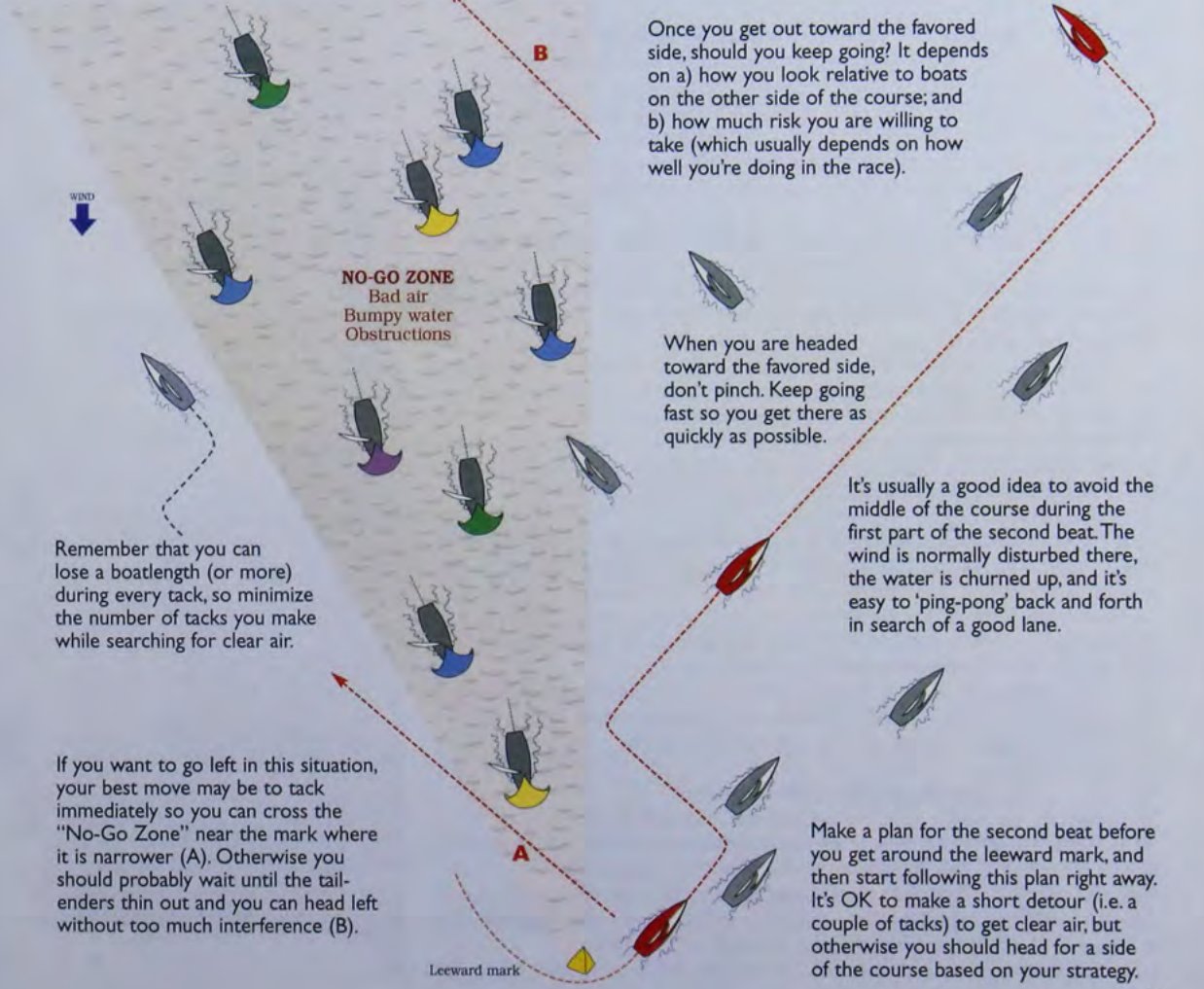
Notes on the diagram:
- Make a plan for the second beat before you get around the leeward mark, and then start following this plan right away. It’s OK to make a short detour (i.e. a couple of tacks) to get clear air, but otherwise you should head for a side of the course based on your strategy.
- If you want to go left in this situation, your best move may be to tack immediately so you can cross the “No-Go Zone” near the mark where it is narrower (A). Otherwise you should probably wait until the tail-enders thin out and you can head left without too much interference (B).
- Remember that you can lose a boatlength (or more) during every tack, so minimize the number of tacks you make while searching for clear air.
- It’s usually a good idea to avoid the middle of the course during the first part of the second beat. The wind is normally disturbed there, the water is churned up, and it’s easy to ‘ping-pong’ back and forth in search of a good lane.
- When you are headed toward the favored side, don’t pinch. Keep going fast so you get there as quickly as possible.
- Once you get out toward the favored side, should you keep going? It depends on a) how you look relative to boats on the other side of the course; and b) how much risk you are willing to take (which usually depends on how well you’re doing in the race).
A good practice idea
When you have three or four (or more) boats together at a practice session, here’s a good way to work on your tactics during the first part of the second beat. Set two marks as a short windward-leeward course. Then have the boats position themselves so they round the leeward mark bow-to-stern in a certain order (e.g. A, B, C, D).
The goal for each boat is to race up to the windward mark and improve or protect their position. After getting there, they start again at the leeward mark. This time send the first boat to the back so you have a different order (e.g. B, C, D, A). Keep doing this so each boat gets to round the mark in every position. Then talk about what everyone learned.
If your class uses gate marks, don’t always round the leeward mark to port. Try doing this drill with a gate, or have everyone round the mark to starboard sometimes.
Originally published as “Tactics – Start the second beat strong” in the BDA Magazine 2005 Annual. © David Dellenbaugh / Speed & Smarts, reproduced in Dragon News by permission. Reproduced with permission.
← Back to the Technical Library