By David Dellenbaugh · BDA Magazine 2006 Annual, pp. 14-15
↓ Readable PDF↓ Original pages (scan)
Strategy for the first beat in an oscillating breeze, where the key is to catch the first shift after the start and stay “in phase” to the windward mark. Dellenbaugh covers finding and updating the median wind direction and your median headings on each tack, tacking when you reach the median rather than at the lowest heading, treating the last shift before the mark as persistent, playing the middle, not chasing other boats’ shifts or trying to cover, and sailing slightly lower and faster on lifts. Three diagrams explain when to tack on a header, why to sail fast on a lift (the polar curve and “target”), and why boats in the middle gain over boats that reach the laylines.
When the wind is shifting back and forth (as it often is), the key to a successful first beat is catching the first shift after the start and then staying “in phase” with the breeze until you reach the windward mark. Here are some ideas on how to do that:
Find the median.
With an oscillating breeze, it’s important to figure out the median, or average, wind direction. This is usually the direction that’s midway between the farthest left shift and the farthest right shift you’ve seen.
Even more useful than the average wind direction are your median headings on each tack. These are the compass courses you are steering when the wind direction is at its median. You should always know whether you are sailing above or below your median on each tack, since this will tell you if you are lifted or headed.
Modify your median.
Once you figure out your median wind direction and headings, don’t stop thinking about them. Sometimes the average wind direction shifts slightly to the left or right as you sail up the first beat. Make sure you notice this and adjust your numbers accordingly (during the first leg and afterward).
Tack on the headers.
Most racing sailors know that, when the wind is oscillating, they should tack on the headers to sail on the lifts. But when you are getting headed, which is the best time to tack?
If you tack when you first start to get headed, you are probably still on a lift (sailing above your median) so that’s not a good idea. If you wait until you reach your lowest heading, you will have sailed lower than average on that tack when you could have sailed above your median on the other tack. The best time to tack, therefore, is when you are at the median (see next page).
Timing is not so important.
In my experience, it’s easier to keep track of the range of shifts than to figure out their timing. So I focus on identifying whether the wind is left or right at any moment, rather than trying to predict when the next shift will come.
There are, however, two times on the first beat when it helps to know about timing. One is at the start when you’re trying to figure out how soon the first shift will come. Another is near the first mark when you need to know whether the wind will shift again before you get there.
The last shift.
When you are approaching the windward mark, treat the last oscillation as if it is a persistent shift. That is, instead of tacking on the header as usual, sail farther into it until you fetch the mark (see Diagram 1).
Play the middle.
It’s usually a good idea to play the middle of the course when the wind is oscillating (see Diagram 3). This helps you stay away from the laylines, which are dead-ends in a shifty breeze. If you start getting too close to a layline, be willing to tack on smaller headers to head back toward the middle.
Don’t chase shifts.
It can be tempting, when you see a boat nearby on a huge lift, to sail toward that shift and try to get it. However, this rarely works. More often than not, you must sail on a header to reach the other boat. And when you get there, half the time that great shift is gone.
It’s better to focus on sailing in the wind you have. Use other boats as a guide to know how much you are lifted or headed, but don’t try to sail for their shift. One exception to this is that it often works to go out of your way for better wind pressure, especially in lighter air.
To cover or not?
It’s very difficult to “cover” other boats when the wind is shifty. You normally cover by staying between the other boat(s) and the next mark. If you try this in an oscillating breeze, however, you are likely to lose.
That’s because if the boat you are covering is playing the shifts perfectly, you won’t be (since you’re in a different breeze than they are). In shifty winds, you must sail your own race first and worry about other boats second.
Sail fast on lifts.
If you are sailing on a lift (and you should almost always be sailing on a lift when the wind is oscillating!), you should sail just slightly lower and faster than normal (assuming you will have to tack at least once more on the beat). This will get you to the next shift sooner and maximize your VMG in the direction of the median wind (see Diagram 2).
1. When to tack on a header
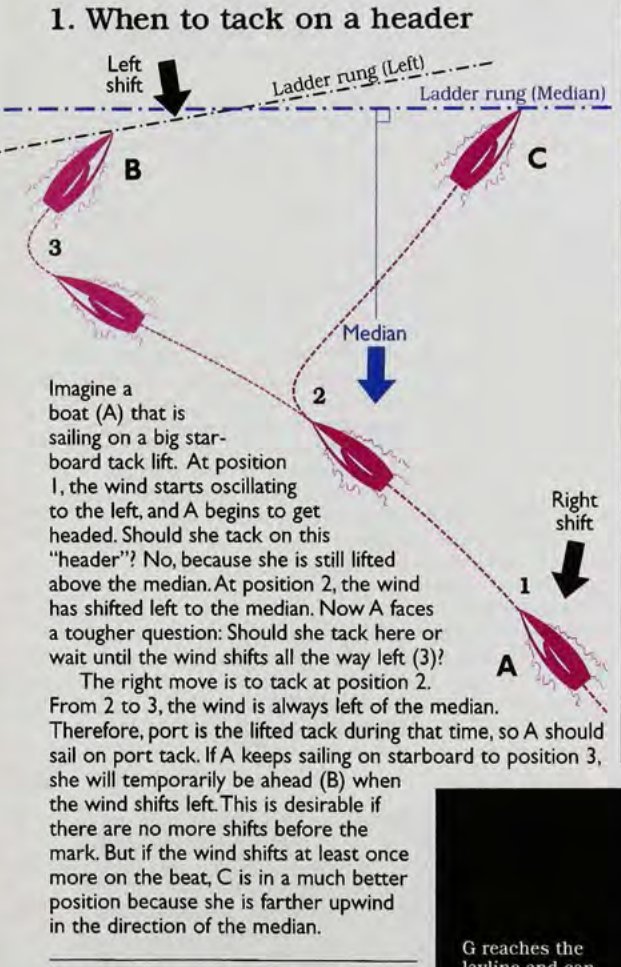
Imagine a boat (A) that is sailing on a big starboard tack lift. At position 1, the wind starts oscillating to the left, and A begins to get headed. Should she tack on this “header”? No, because she is still lifted above the median. At position 2, the wind has shifted left to the median. Now A faces a tougher question: Should she tack here or wait until the wind shifts all the way left (3)?
The right move is to tack at position 2. From 2 to 3, the wind is always left of the median. Therefore, port is the lifted tack during that time, so A should sail on port tack. If A keeps sailing on starboard to position 3, she will temporarily be ahead (B) when the wind shifts left. This is desirable if there are no more shifts before the mark. But if the wind shifts at least once more on the beat, C is in a much better position because she is farther upwind in the direction of the median.
2. Why you should sail fast on a lift
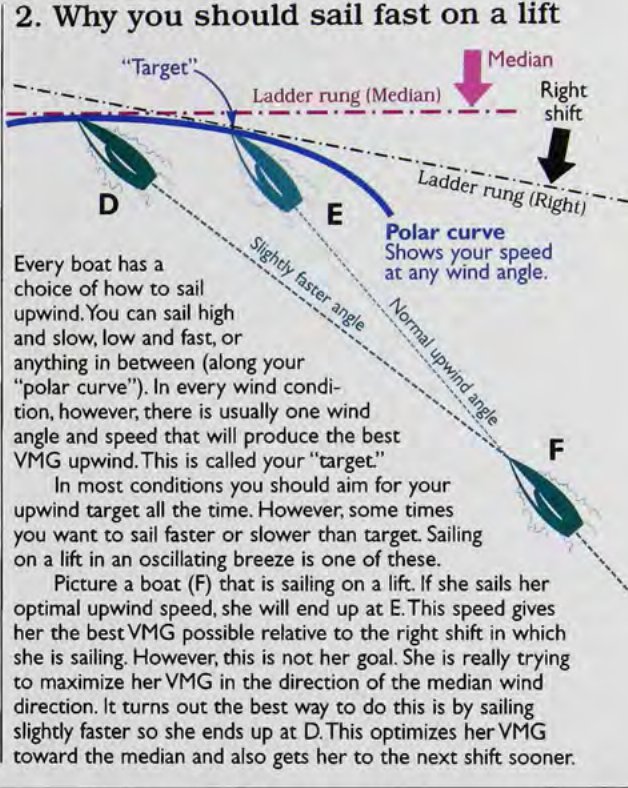
Every boat has a choice of how to sail upwind. You can sail high and slow, low and fast, or anything in between (along your “polar curve”). In every wind condition, however, there is usually one wind angle and speed that will produce the best VMG upwind. This is called your “target.”
In most conditions you should aim for your upwind target all the time. However, some times you want to sail faster or slower than target. Sailing on a lift in an oscillating breeze is one of these.
Picture a boat (F) that is sailing on a lift. If she sails her optimal upwind speed, she will end up at E. This speed gives her the best VMG possible relative to the right shift in which she is sailing. However, this is not her goal. She is really trying to maximize her VMG in the direction of the median wind direction. It turns out the best way to do this is by sailing slightly faster so she ends up at D. This optimizes her VMG toward the median and also gets her to the next shift sooner.
3. Stay in the middle
Why does it usually work to stay near the middle of the course when the wind is oscillating? Assume that three boats (G, H and J) start a race at different positions on the line as shown. The wind is a classic oscillating breeze that shifts regularly back and forth across a steady median. For our example, assume the wind shifts equally and simultaneously for all three boats. If each boat plays the shifts perfectly, they will all tack at the same time and will always be on the same tack.
For most of the first beat (the first 4 shifts), these boats are equal with each other. That is, they all make the same progress upwind in the direction of the median breeze. Before the 5th shift, however, G faces a problem. She must either tack off the lift or sail past the layline. In either case she will lose ground to the other boats. J faces the same problem before the 6th shift. Only H, which is in the middle, can continue playing the shifts properly all the way to the mark. That’s why she’ll come out ahead.
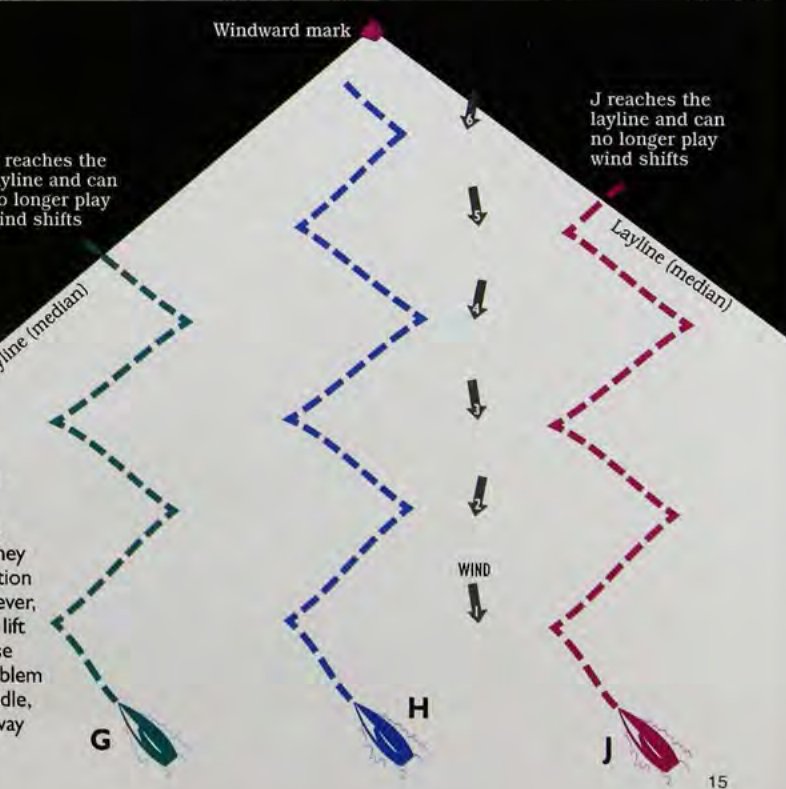
- G reaches the layline and can no longer play wind shifts.
- J reaches the layline and can no longer play wind shifts.
Originally published as “How to sail fast up the first beat when you have Oscillating shifts” in the BDA Magazine 2006 Annual. © David Dellenbaugh / Speed & Smarts, reproduced in Dragon News by permission. Reproduced with permission.
← Back to the Technical Library