By Dave Dellenbaugh (selected by Graham Bailey) · IDA Yearbook 2017 (2016 Review • 2017 Preview), pp. 18-21
↓ Readable PDF↓ Original pages (scan)
Twenty short tips from Dave Dellenbaugh’s Speed & Smarts, chosen by Graham Bailey for Dragon sailors, mostly on wind-shift strategy. Key ideas: establish a median heading for each tack and tack when knocked to it, decide whether shifts are oscillating or persistent, sail slightly faster on lifts, and use the ‘10-25’ rule (a 10° shift gains or loses about 25% of lateral separation, 5° about 12%). Other tips cover trimming the main so the top batten is parallel to the boom, rounding marks with the mark at the bottom of the arc, gybing on the lifts downwind, and the fact that a boat’s wind shadow reaches about 10 lengths in light air but only about 5 in heavy air.
As selected by Graham Bailey
Below is a selection of excellent tips on strategy, tactics and speed courtesy of the hugely respected shift-master, Dave Dellenbaugh who also offers some helpful hints on keeping your head together when it goes wrong. These are all of application to Dragon class racing and I would perhaps add one observation: The difference between the leaders and the mid fleet boats is a lot less than you might think. Our good friend and local Cowes fleet sailor, Dave Ross, discovered this for himself at a recent regatta in Cascais when much to everyone’s surprise (not least his own), he won two clean races in one day against a rock-star line up. He told me afterwards that he didn’t do anything different to his usual except he stopped moving the tiller and held the boat in a fractionally higher groove – next thing he was off like a robber’s dog and some of the very best sailors in the world could not catch him. Marvellous class where the boats are so close in performance that a passionate amateur can take on the world and on his day – win. We are all learning all the time and each of us can take something away from the following.
1. Stay in the hunt.
Never give up! No matter how hopeless your position seems, the race is not over until all the boats cross the finish line. There are many times when large changes can happen late in the race, so keep plugging. Catching just one or two boats may make a big difference at the end of the series. At least use the rest of the race to practice your boat handling, work on speed and figure out the wind so you will be stronger in the next race.
2. Play the time and distance guessing game.
This is an easy to play game that will help you tune your sense of time and distance. When you are practicing, heading out to the race course, or sailing around between races, pick a fixed point up ahead and ask everyone to guess how long it will take you to get there. Then start your watches! It’s fun, contagious, competitive and will help your starting!
3. Use a line sight!
One extremely valuable tool for starting is a “line sight” (or range) using the pin end of the line and a point on the shore behind it. Get a line sight for every start (if possible) by sailing just outside the committee boat and looking through the pin end toward the land beyond. By lining up these two points as you approach the start, you’ll know exactly where the starting line is.
4. Pick a median.
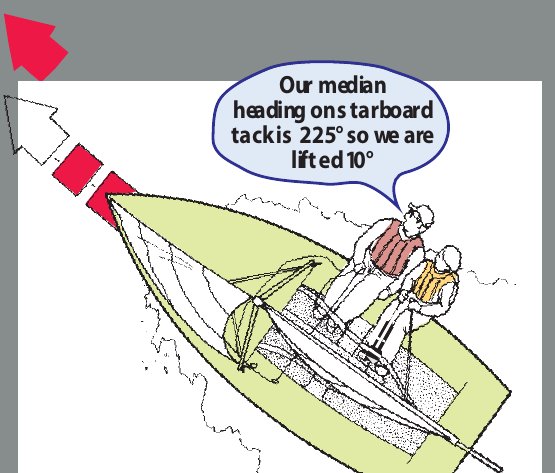
When the wind direction is oscillating, it’s key to figure out the median, or average, wind direction. This is usually the direction that’s midway between the farthest left shift and the farthest right shift you’ve seen. It’s critical to know this number because your strategic choices hinge on whether the wind is to the left or right of this median. So always choose a median heading for each tack, and remember these numbers may change during the race.
5. Oscillating or persistent?
In most races, the windshift pattern is either oscillating or persistent. On every leg, you must decide which way you are going to play the wind. This decision influences many of your strategic and tactical moves and will greatly affect your success. For example, if you think the wind is shifting persistently, you should sail into a header. But if the wind is really oscillating, you will lose a lot by doing this. So, is the wind oscillating or persistent?
6. Sail fast on a lift.
In a shifty wind, it’s usually better to sail slightly faster than normal while you are on the lifted tack. This maximizes your VMG in the median wind direction. And second, it brings you to the next shift (header) sooner. The more you are lifted, the faster you should sail. As you get headed down to the median, slow down slightly until you are sailing at your normal upwind speed and angle.
7. Use the ‘10-25’ rule.
Few sailors know how much they gain or lose when the wind shifts. Here’s an easy guide: In a 10° shift you will gain or lose roughly 25% of the lateral separation (perpendicular to the wind direction) between you and other boats. Remember this as the ‘10-25’ rule. If the wind shifts 5°, the gain or loss will be roughly half (12%) and so on. If you know the starting line length, you can use this rule to figure out the advantage of starting at either end.
8. Protect the right side.
If other factors are equal, protect the right side of the beat since that will give you the starboard-tack advantage when you converge with other boats. This is especially important on short beats and whenever you are close to the windward mark. On runs, protect the left side (looking downwind) since this will put you on starboard tack and inside as you approach the leeward mark.
9. Minimise helm downwind.
When sailing upwind, it’s good to have a bit of windward helm to give the rudder more feel and lift. But on a run or reach an off-centre rudder just creates drag, and this is slow. Therefore, adjust the trim of your boat and sails to keep your rudder centred and your helm neutral as much as possible. The boat should almost steer itself in a straight line.
10. Top batten parallel.
Getting the right main trim is critical for good speed in any condition. If you over-trim the main, it will stall and be slow. If you under-trim the main, you’ll be faster, but you won’t be able to point. The key is finding a happy medium that works for both speed and pointing. The easiest guideline is trimming the sheet so the top batten is parallel with the boom. In light air and lump, let the top batten angle off to leeward a bit. In flat water and more wind, trim the sheet hard enough so the top batten angles to windward.
11. Don’t always swing wide.
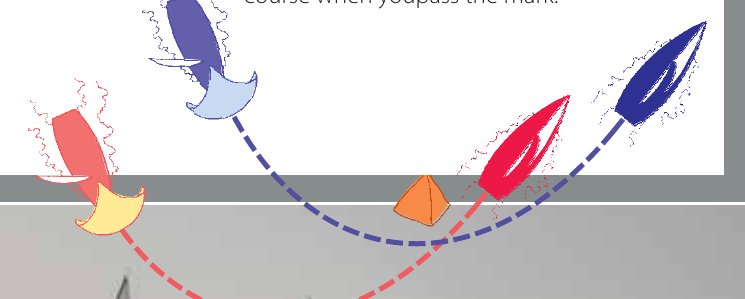
Conventional wisdom says you should round a mark by swinging wide on the near side and close on the far side (like the red boat below). However, this is not the fastest way to get around the mark. Unless you are worried about your position relative to other boats, it’s better to approach the mark closer on the near side, pass it on a beam reach, and end up farther from the mark as you turn up to close hauled (like the blue boat). The key is making your turn so the mark is at the bottom of your arc; if you don’t do this you will sail extra distance. Of course, there may be tactical reasons (e.g. boats just ahead or behind) why it makes sense to round wide and tight so you are on a closehauled course when you pass the mark.
12. Go fast first, then point.
The ability to point high is great for tactics, strategy and speed, but you can’t just aim your boat closer to the wind. Pointing ability is closely tied to speed, so in order to point higher you must start by going faster. This gets the water flowing faster over your foils, which increases their efficiency and produces lift. When pointing is a problem, the natural response is simply to turn the boat towards the wind, but this is the opposite of what’s needed. Instead, you should aim lower and go faster first – then slowly try pointing higher. (Of course, you may also need to make other changes to improve pointing).
13. Take your chute down early.
One of the costliest mistakes at leeward marks is leaving your chute up too long. Carrying your spinnaker for an extra length or two will gain you only a small distance, but a takedown snafu can cost you tons. Therefore, unless you are fighting for an inside overlap, make the smart, conservative choice by dropping a little early and not risking a bad takedown.
14. Don’t manoeuvre in lulls.
Another good rule of thumb is that you should never make a manoeuvre in a lull unless you have a very, very good reason. Whenever possible, time your manoeuvres (e.g. tacks, gybes) so you perform them in good wind pressure. If you make turns without much wind you will lose a lot in each manoeuvre.
15. Tack when headed to the median.
When the wind is shifty, your basic strategy is to tack on the headers. But exactly when is the best time to tack? The biggest mistake for most sailors is sailing too far into the header. If you keep going until you get the maximum shift, you will sail roughly half the beat on headers instead of lifts, which is not fast. To avoid this, tack when you get knocked to your median heading.
16. Avoid bad air.
Boats always cast wind shadows, but these are more harmful in light air. When a stream of slow moving air is interrupted (e.g. by a boat’s sail plan), it takes a long time for that stream to return to normal. In light air, you may feel another boat’s shadow as far as 10 lengths away, and when you are in that shadow, you may have only half as much wind as boats in clear air. This is a problem because you were already under powered. In heavy air, the wind stream re-forms much more quickly, so you might feel a shadow only 5 boat lengths to leeward of another boat. And that won’t hurt as much because you still have relatively strong breeze.
17. Wave a port tacker across
When you have a good lane on starboard tack and you want to keep going toward the left side, don’t automatically yell “starboard” to every port tacker that tries to cross in front of you. Having them tack on your lee bow is probably not the best thing. It’s often much better to let the other boat go across, even if this means you will lose a little by bearing off behind them. When you are still several lengths away, yell “Go ahead,” or other words to make it clear they can keep going. Just be sure to communicate loudly and clearly.
18. Gybe on the lifts.
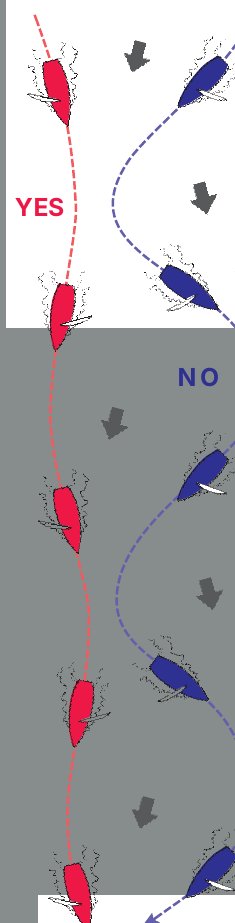
When you’re sailing upwind in an oscillating breeze, you should tack on the headers so you sail on the lifts. On runs, however, you want to gybe on the lifts so you sail on the headers. By gybing each time you are lifted, you will always be sailing away from the next shift (the right move on runs), and you can sail lower and closer to the leeward mark (i.e. you’ll climb down the ladder rungs and maximise VMG to leeward).
19. Drop out of the sky.
One of the toughest things about coming from behind is psychological. The key is to stay focused on the present and not get hung up on how you ended up near the back of the fleet. Here’s a psychological game I play when I find myself back in the pack: I pretend that someone else was driving the boat and got it into a bad position. Then I was magically dropped onto the boat from an airplane to help make a comeback. This does a number of things: 1) it keeps me from blaming myself for making a mistake; 2) it helps me look at the current situation objectively; and 3) it gets me psyched up for the challenge of improving my position during the rest of the race.
20. Stay on the favoured side of other boats.
When your strategy says the right side of the course is favoured, it may not be enough simply to sail toward that part of the beat or run. If all the other boats go even farther right, you are actually on their left, which is not good. Since your only goal in the race is to beat your competitors, you must use your strategy to position yourself relative to them. If you like the right side, for example, you should generally stay on the right side of the boat (or boats) you want to beat.
Originally published as “Dave Dellenbaugh’s top Speed & Smarts tips for Dragon sailors” in the IDA Yearbook 2017 (2016 Review • 2017 Preview). © David Dellenbaugh / Speed & Smarts, reproduced in the IDA Yearbook by permission. Reproduced with permission.
← Back to the Technical Library