By B. H. Coleman · BDA Magazine 2012 Annual, pp. 18-20
↓ Readable PDF↓ Original pages (scan)
A late-1940s article by B. H. Coleman, reprinted from Yachting World, on getting the best out of a Dragon. He finds most British boats too heavy, badly trimmed fore and aft, with masts stepped too far aft and crews short of practice; he advises concentrating weight at the forward end of the cockpit, moving the mast a few inches forward to cure hard-mouthed helm, keeping the mast straight with lowers slightly slacker than uppers, and setting runners with Highfield levers for equal tension. He also covers tacking drill, movable genoa leads, hoisting and handing the spinnaker in ten seconds, and the value of practice as seen in Scandinavian crews.
“Why didst thou leave the trodden path of men
Too soon, and with weak hands though mighty heart
Dare the unpastured dragon in his den?”— Percy Bysshe Shelley
Ships are sentient beings, and it is not easy to generalize on how to get the best out of a boat of a class with a One-Design hull, but taking a cross section of the Dragons in this country, four points stand out:—
- The majority are too heavy.
- Not enough care is taken with fore and aft trim.
- The mast is stepped too far aft, and not enough care taken to keep it straight.
- The crews are not experienced enough and often have to work with out-of-date gear.
When Johan Anker designed the class, he had in mind a pleasant little cabin boat which, apart from being raced, could be used for week-end cruising. Unfortunately the rules regarding the size and accommodation of the cabin are so elastic as to permit, on the one hand a beautifully fitted cabin, and on the other a small shelter on an otherwise open cockpit. For first-class racing, it is obvious that weight is at such a premium that the cabin has to be kept as small and austere as possible, and so it is necessary, regretfully, to depart from Anker’s original intention of a racing-weekender and concentrate on saving weight.
Apart from keeping the construction as light as possible, every piece of wood and every metal fitting should be carefully considered as to whether it is absolutely necessary, and if so, whether it could not be lighter. This may seem to be going too far, but unnecessary weight is a heavy penalty in light weather.
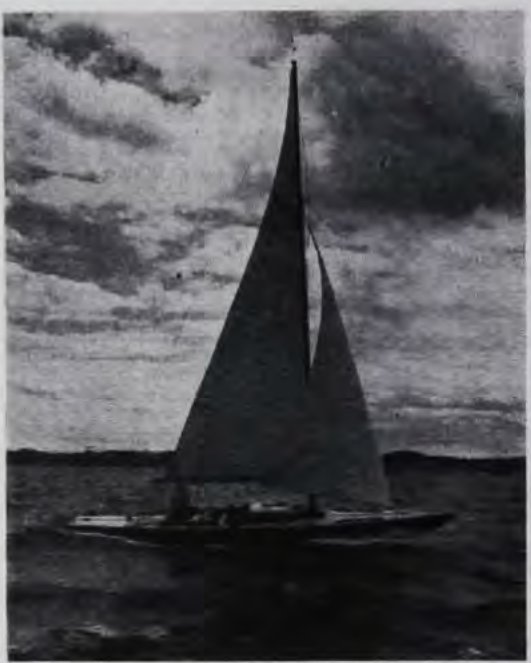
In order to make the most of the inherent qualities of the hull, great care must be taken with the fore and aft trim. The Dragon is somewhat like a see-saw, and it is thus necessary to concentrate a great part of the weight, including that of the crew, near the centre of the boat, that is, at the forward end of the cockpit. The only sure way of knowing whether the boat is trimmed correctly or not, is, of course, by trial and error over a series of races, although it is possible to judge fairly accurately by seeing how she lies on the water. Another useful guide when on the wind is that the leeward quarter wave should leave the hull abreast the rudder head.
Most Dragon owners I have talked to have complained that their boats have a tendency to be hard mouthed in a breeze. With my own boat Robelia I found the same thing, and no amount of alteration in the rake of the mast would cure it. The answer is that although the mast is positioned according to the plans, it is too far aft. The rules do not specify the position of the mast in the fore and aft line, and moving the mast a few inches forward would help to reduce this tendency.
The Scandinavians (especially the Danes), have been bending their masts into odd shapes in order to get a better aerofoil; but in this country, where undue strain on the mast is undesirable owing to the frequency with which we race in rough water, it is wiser to keep the mast as straight as possible. This, I admit, is not easy in a Dragon with the short spread at the base of the shrouds, and it is not uncommon to see a huddle of Dragons closehauled, all with their masts sagging to leeward.
I remember once, Mr. Yule-Oldham when he was Commodore of the Cambridge University Cruising Club, talking to a group of enthusiastic young men, and explaining forcibly while making a shaking movement with his hand “You should be able to do that with the rigging!” This is the old-school of thought and certainly does not hold good with the new rigging plan of the Dragon. The upper shrouds especially must be tight but it pays to have the lower shrouds a little slacker than the upper ones, so that the weight of the wind in the sail will tend to push the lower part of the mast to leeward, and thus bring the unsupported top of the mast up to windward.
It is perhaps unnecessary to stress the importance of having the same shroud tension on either side, but many people forget that this also applies to the runners. Many Dragons in this country use the old-fashioned method of having their runners on a wire span, and I defy anyone to ensure equal tension on the runners by this method. One way of overcoming this is to lead the runner through a block on the covering board to a Highfield lever. With the aid of a rigging screw, it is possible to adjust the tension on the two runners exactly, and when the Highfield lever is set up, the tension will be correct. It also pays to lead the runners as far aft as conveniently possible so as to increase the angle between the stay and the mast.
Many keen helmsmen are inclined to accumulate a large number of racing sails. This is not really necessary but it pays to have two racing suits; one cut full, for light weather, and the other flat for heavy weather. The light weather spinnaker should be made of the lightest possible material. The rules only allow one suit of sails to be carried during a race, so to have more than two only gives the helmsman a greater headache before the race, wondering what the weather is going to do.
Before discussing the difficulties of the crew, it is worth mentioning the surface of the boat’s bottom and in fact of any part of the topside which is immersed when under way. Although this applies to all racing yachts, it is ignored by a surprising number of owners. The hull must be kept as clean and as smooth as possible. Many people try to reassure their consciences by telling themselves that a few days growth of slime makes the bottom even smoother, but then the ostrich thinks he cannot be seen when he has his head in the sand.
The other day a friend of mine suggested that I crewed him in his Dragon for the first race of the season. I pointed out to him that I would very much like to, but that as I had never been on board his boat before, I would probably not be very much use. “Oh, never mind,” he said, “we will have some fun anyway.” Have some fun we did, and I enjoyed myself, even though I did tear his spinnaker trying to get it up smartly, but we didn’t win the race. If you intend to race seriously, it is essential to have a well-trained crew and always to sail together.
A Dragon does not like beating under mainsail alone, and many seconds can, therefore, be lost each tack if the genoa is not sheeted home at the right moment. The best drill when tacking is for one member of the crew to cast off the leeward jib sheet just as the genoa is caught aback, while the other with three or four turns round the sheet winch gets in as much slack as he can. He then lays back on the sheet while the first man gets the last bit in with the winch.
When beating it is important to have the genoa sheet lead in the right place. As this varies according to the strength of the wind, it is useful to have a movable lead. On my Dragon I have fitted a track running from the shrouds right to the counter on each covering board. Each track carries two light snatch blocks for the genoa, and two for the spinnaker, and the trim of both these sails can be adjusted quickly and easily. With the genoa, the leach is tightened by moving the lead forward, and the foot is tightened by moving it aft.
In normal circumstances, the crew have their hands full with the genoa, and it helps if the helmsman can operate the runners. With Highfield levers this is not a difficult operation, especially if, as on some Dragons, one Highfield lever is used which works both ways and in one operation sets up one runner and casts off the other.
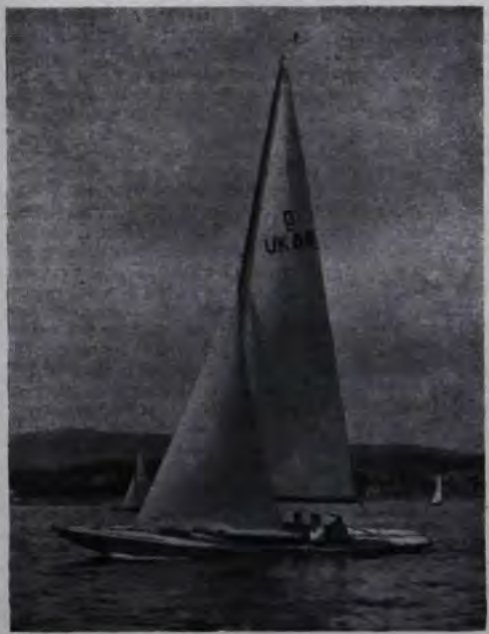
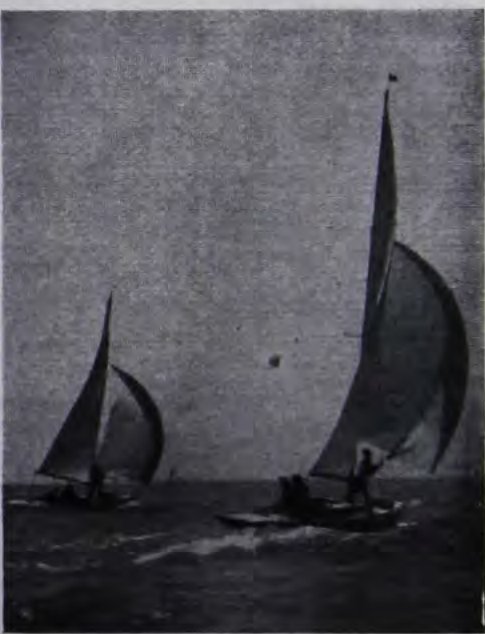
There seems little need to stress the importance of speed and efficiency in spinnaker drill. The spinnaker should be up and drawing in ten seconds after rounding the mark, but it is surprising how many crews make heavy work of it, and I have seen boats take as long as ten minutes. Provided a few main principles are kept in mind, the spinnaker work in a Dragon is not difficult.
On paper the sequence in which the various sails are handled seems only too simple: immediately after rounding the mark the spinnaker is hoisted and made to draw, and the genoa lowered. When handing the spinnaker, the procedure is reversed. There is nothing difficult in that, but it takes a crew a little while to be able to hoist a spinnaker in ten seconds, let alone make it draw.
Many ingenious methods of setting the spinnaker are used, such as hoisting it in a paper bag, in stops, or from a canvas bag on the fore-deck. Since a Dragon spinnaker is comparatively small, all these methods are really rather superfluous, and it is much easier to hoist the spinnaker straight up from the fore-deck to leeward of the genoa where it will remain quiet until it is made to draw.
When the mark is reached, the spinnaker should be lying on the fore-deck, with the sheet attached to one clew and set at a predetermined length. The other clew should be led round the forestay and attached to the spinnaker boom and guy, and the leeward halyard clipped to the head. When I talk about leeward and windward, I mean what will be leeward and windward after rounding the mark and steadying on the next course. As soon as the helmsman orders “up spinnaker” the inboard end of the spinnaker boom is clipped to its fitting on the mast, the spinnaker is run up and the halyard made fast round the jamb cleat. The fore-deck hand can then bring the spinnaker boom, which will still be lying in the fore and aft line of the ship, round to the required angle, while the slack of the guy is taken in by the other member of the crew. As soon as the spinnaker catches the wind, and provided that the sheet has been pre-set fairly accurately, it will draw straight away. While the cockpit hand trims the spinnaker, the fore-deck hand can lower and stow the genoa.
When handing the spinnaker, the genoa must be hoisted first and sheeted home. Then the spinnaker sheet is let fly, and the boom is detached from the mast and sail and thrown aft into the cockpit. With a judicious pull on the guy, the spinnaker collapses and at the same moment the fore-deck hand casts off the halyard, and lets it run, taking care that the tail does not disappear up the mast. If properly timed, the spinnaker will fall in a nice little heap on the fore-deck, and even if something does go wrong, the spinnaker will only blow against the genoa and not overboard.
To save time and unnecessary movement in the boat both sheet and guy should remain rove throughout the race, being hooked to the forestay when not in use. Incidentally, in light weather, particularly, the crew must avoid unnecessary movement because this reduces the speed of the boat.
The position of the spinnaker when set should be as high as possible. A useful fitting is a ring which slides on a track on the leading edge of the mast, reaching from the deck to a point about 6ft up. This not only allows adjustment to the height of the spinnaker boom, but also allows the ring to be slipped down to the base of the mast when not in use, so that the genoa sheets do not catch on it.
The actual trimming of the spinnaker can only be attained with practice, and it takes both members of the crew to do it properly, but it is not an uncommon sight on some Dragons to see one of the crew perched on the main boom to keep it down. His time is wasted up there, and it is much better to fit a kicking strap, or boom-vang as our American contemporaries call it. I admit that this is not so easy to fit as in a dinghy, and it is usually better to hook the bottom end to an eye bolt on the side deck, only remember to let it go before gybing, or else!
So far, I have merely referred to hoisting and lowering the genoa, but obviously the quicker this is done the better. On Robelia there is an eye in the halyard which, when the genoa has been hoisted, slips over a hook on the mast, the tension on the luff being obtained by having a downhaul on the tack. This downhaul runs through the fore-deck, through a block and aft to a Highfield lever on the cockpit floor. When hoisting the genoa, all the fore-deck hand has to do is to run it up, hook the eye over the hook on the mast; the cockpit hand then sets up the Highfield lever, and there you are. When lowering, the procedure is reversed.
One last point which is, of course, not solely applicable to Dragons, and that is the question of practice. It was painfully obvious during the Olympic Games and the final trials that the majority of British helmsmen and crews were sorely lacking in practice and experience. Whereas in England we race once, or at the most twice, a week, the Danes, Norwegians and Swedes race four evenings a week, and spend the other three tinkering about or having private duels. I am not blaming English helmsmen, because they have neither the time nor opportunity to race more often, but the fact remains that if we want to sail to win, we must get as much practice as possible.
Originally published as “Tuning Tips 1940’s Style – Sailing a Dragon to Win” in the BDA Magazine 2012 Annual. © B. H. Coleman and the British Dragon Association. Reproduced with permission.
← Back to the Technical Library